 Qubit Zoo
Figure
Description
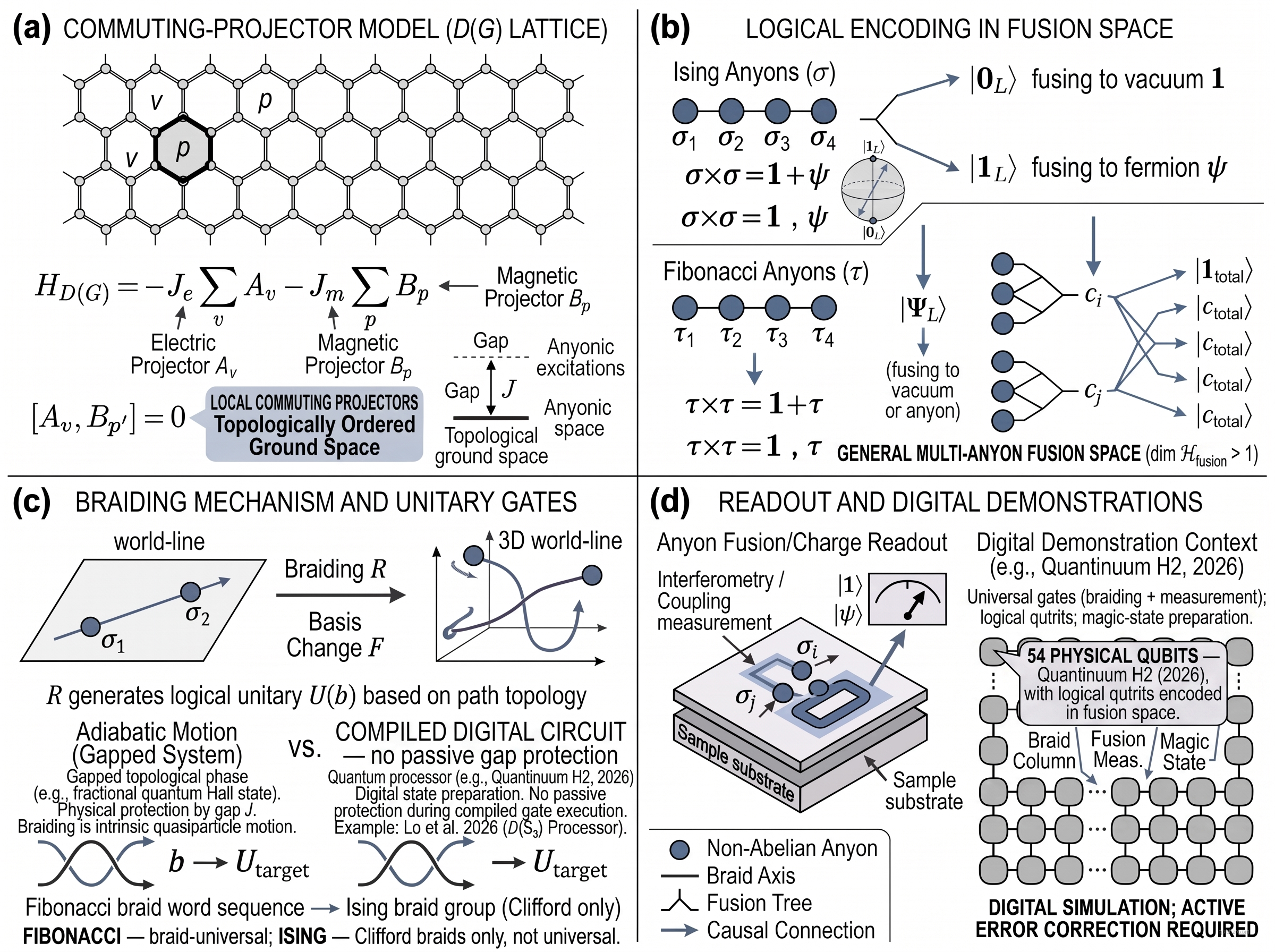
A topological qubit stores quantum information nonlocally in the degenerate fusion space of non-Abelian anyons. If anyons of types and can fuse through more than one channel,
then a collection of anyons can have a multidimensional state space that cannot be distinguished by measurements confined to one anyon. Exchanging neighboring anyons acts on that space through braid matrices and basis changes between different fusion orderings are described by matrices. A braid word therefore implements a logical unitary that depends on the topology of the world lines, ideally making small deformations of the path irrelevant.
The phrase covers several realizations. Majorana zero modes behave as Ising-type anyons and are treated separately in majorana-topological-qubit. Programmable processors can instead synthesize non-Abelian topological order and manipulate emergent anyons with quantum circuits. These digital demonstrations validate fusion and braid algebra, but their gates are not automatically protected by a persistent many-body gap; physical gate errors remain unless active error correction or a genuinely gapped implementation supplies protection.
Logical Encoding and Gates
For Ising anyons,
and four anyons with fixed total charge can encode one logical qubit in two fusion channels. Braiding realizes Clifford operations, so a non-Clifford resource is still required for universal computation.
For Fibonacci anyons,
and the fusion space of three or four anyons can encode a logical qubit. Fibonacci braid-group representations are dense in the logical unitary group, allowing universal computation by braiding in principle. Other non-Abelian orders need not be braid-universal: the 2026 experiment obtained universality by combining braiding with fusion/charge measurement and demonstrated logical-qutrit readout and magic-state preparation.
Representative Hamiltonian
There is no single microscopic Hamiltonian for every topological qubit. A representative family is Kitaev’s quantum-double commuting-projector model,
where enforces the local gauge constraint and projects onto trivial flux. The projectors commute,
so the ground space is topologically ordered and localized violations of the vertex or plaquette constraints are anyonic excitations. For a non-Abelian group such as , the resulting quantum double supports non-Abelian anyons and nontrivial fusion spaces. The Hamiltonian prepares and energetically separates the code space; logical operations are described by string/ribbon operators and their braid-group action, not by treating the anyon pair as an ordinary two-level local Hamiltonian.
The 2024 Fibonacci processor experiment instead simulated a Levin-Wen string-net model,
with commuting vertex and plaquette projectors. Its braids were compiled into physical gates rather than generated by adiabatic quasiparticle motion, which is why that experiment demonstrated the algebra of Fibonacci anyons without intrinsic energetic protection during the braid.
Motivation
- Nonlocal storage: local operators cannot directly distinguish or rotate ideal logical states in a well-separated fusion space.
- Geometric gates: braids depend on world-line topology rather than detailed pulse trajectories.
- Hardware-level error suppression: a gapped topological phase could suppress local errors before conventional fault-tolerant overhead is applied.
- Alternative route to universality: Fibonacci braiding is universal in principle; other orders can become universal when braiding is augmented by fusion measurement or magic-state resources.
Experimental Status
Projective Ising anyons on a superconducting processor (2023): Google Quantum AI created and braided non-Abelian graph-vertex defects in a generalized stabilizer code and used braiding to entangle three encoded logical qubits. This was a digital code-space realization, not a materials-intrinsic anyon platform.
Non-Abelian order on trapped ions (2024): Iqbal et al. prepared a 27-qubit non-Abelian topological state with fidelity per site above 98.4%, created and moved anyons, and detected a Borromean-ring braiding process.
Fibonacci braiding on superconducting qubits (2024): Xu et al. prepared a 27-transmon Fibonacci string-net state, measured average vertex and plaquette expectations of 0.94 and 0.58, and obtained a quantum dimension versus the ideal . Because the braids were circuit-compiled, the authors explicitly noted that they were not topologically protected during execution.
Universal braiding-plus-fusion gates (2026): Lo et al. prepared a 54-qubit topological wavefunction on Quantinuum H2, encoded logical qutrits in the global fusion space, implemented a universal gate set using braiding plus anyon charge measurements, and topologically prepared a magic state. This is the strongest processor-level demonstration as of October 2026, while still relying on a digitally prepared state rather than passive protection from a native topological medium.
Impurity interferometry proposal (2026): Debortoli and Grusdt proposed using spin-addressable mobile impurities and Ramsey interferometry to measure - and -matrix elements for Ising or Fibonacci anyons and to transfer a flying qubit into a topological memory. It is a proposal, not an experimental demonstration.
No experiment has yet shown a scalable, materials-intrinsic non-Abelian topological qubit with fault-tolerant protected logic under a complete control and readout stack.
Key Metrics
| Metric | Value | Notes | Fidelity reference |
|---|---|---|---|
| Trapped-ion non-Abelian state | 27 physical qubits; fidelity per site | Adaptive-circuit topological order | Iqbal et al. 2024 |
| Fibonacci processor state | 27 transmons; , | Digital Levin-Wen string-net realization | Xu et al. 2024 |
| Fibonacci quantum dimension | (ideal ) | Extracted from fusion/braiding measurements | Xu et al. 2024 |
| Universal demonstration | 54 physical qubits; logical qutrits; magic-state preparation | Braiding plus fusion measurement | Lo et al. 2026 |
| Intrinsically protected logical-gate fidelity | Not yet established | Digital simulations do not by themselves supply gap protection during compiled braids | Lo et al. 2026 |
References
Foundations
- A. Yu. Kitaev, “Fault-tolerant quantum computation by anyons,” Annals of Physics 303, 2-30 (2003) — arXiv:quant-ph/9707021
- C. Nayak, S. H. Simon, A. Stern, M. Freedman, and S. Das Sarma, “Non-Abelian anyons and topological quantum computation,” Rev. Mod. Phys. 80, 1083 (2008) — arXiv:0707.1889
Processor demonstrations and recent proposal
- M. Iqbal et al., “Non-Abelian topological order and anyons on a trapped-ion processor,” Nature 626, 505-511 (2024) — arXiv:2305.03766
- S. Xu et al., “Non-Abelian braiding of Fibonacci anyons with a superconducting processor,” Nature Physics 20, 1469-1475 (2024) — arXiv:2404.00091
- C. F. B. Lo et al., “Universal gates from braiding and fusing anyons on quantum hardware,” Nature 655, 591-597 (2026) — arXiv:2601.20956
- F. Debortoli and F. Grusdt, “Interferometric braiding of non-Abelian anyons,” arXiv:2610.06203 (2026)
Linked Papers
- kitaev-2003-fault-tolerant-computation
- nayak-2008-non-abelian-anyons-and-topological-quantum-computation
- iqbal-2024-non-abelian-topological-order-and-anyons-on-a-trapped-ion-processor
- xu-2024-non-abelian-braiding-of-fibonacci-anyons-with-a-superconducting-processor
- lo-2026-universal-gates-from-braiding-and-fusing-anyons-on-quantum-hardware
- debortoli-2026-interferometric-braiding-of-non-abelian
Evergreen context
- threshold-theorem — topological encoding still needs a quantitative below-threshold noise model; digital anyon demonstrations are not evidence that passive protection has already been achieved.
Related Entries
- majorana-topological-qubit — hardware proposal based on Majorana/Ising-type fusion spaces
- tetron-qubit — four-Majorana fixed-parity architecture
- surface-code-logical-qubit — Abelian topological code using active stabilizer measurement
- color-code-logical-qubit — another actively corrected topological code family
- quantum-gate — physical and logical gate mechanisms across platforms