 Qubit Zoo
Figure
Description
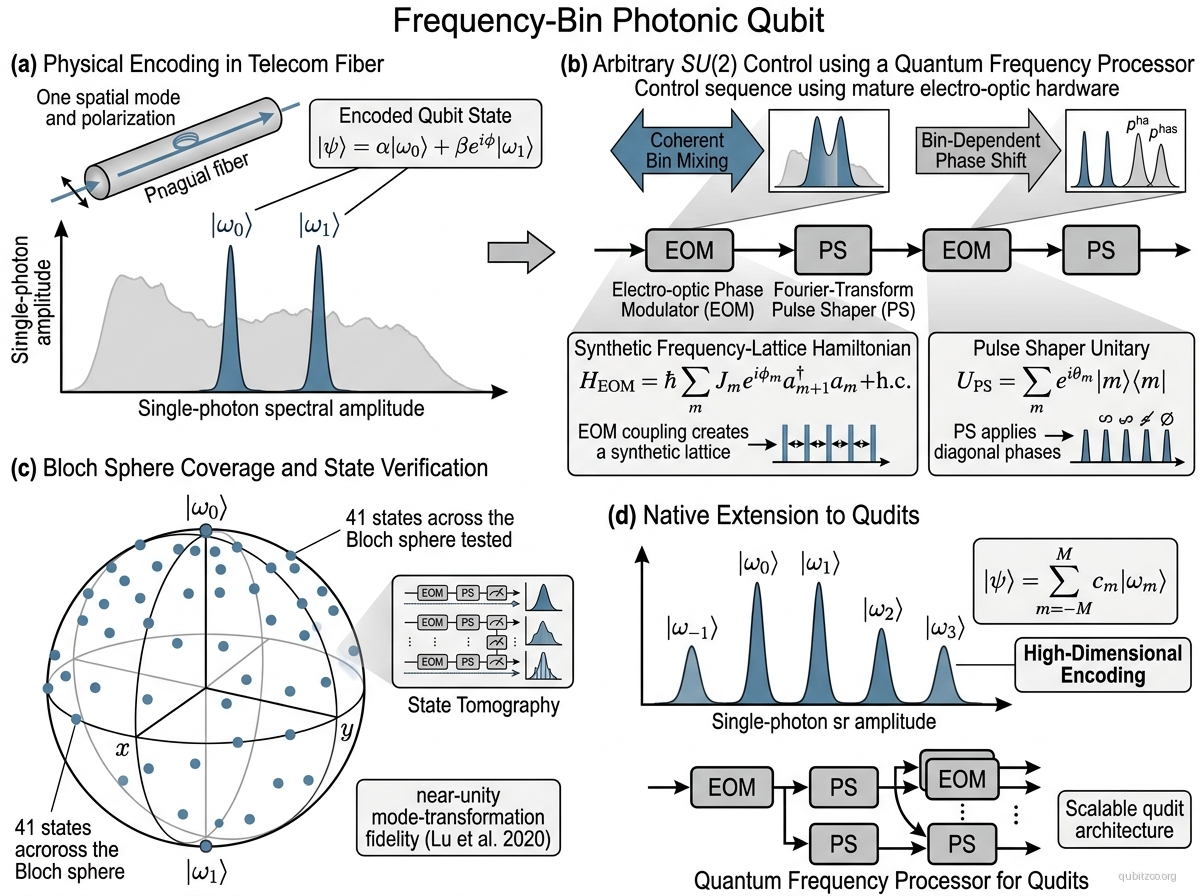
A frequency-bin photonic qubit uses two discrete optical frequency modes of a single photon,
Electro-optic phase modulators coherently mix bins, while Fourier-transform pulse shapers apply bin-dependent phases. The same hardware naturally extends from qubits to high-dimensional qudits. Frequency modes share one spatial path and polarization, making them stable in fibre and compatible with dense wavelength multiplexing.
Hamiltonian and Control
An electro-optic modulator driven at the bin spacing creates a synthetic frequency-lattice coupling,
while a pulse shaper applies . Alternating these operations synthesizes arbitrary rotations on a selected pair of bins and more general unitaries on frequency-bin qudits.
Motivation
- Use telecom-compatible spectral multiplexing without multiplying spatial paths.
- Perform reconfigurable transformations using mature electro-optic and pulse-shaping technology.
- Scale naturally to qudits and parallel frequency channels.
Experimental Status
Lu et al. demonstrated fully arbitrary control of frequency-bin qubits in 2020. A quantum frequency processor implemented all fundamental rotations, tested 41 states across the Bloch sphere, and achieved near-unity mode-transformation fidelity with state verification by Bayesian tomography.
Key Metrics
| Metric | Value | Notes | Fidelity reference |
|---|---|---|---|
| Control coverage | Arbitrary | 41 tested Bloch-sphere states | Lu et al. 2020 |
| Mode-transformation fidelity | Near unity | Fundamental rotations in a quantum frequency processor | Lu et al. 2020 |
| Native extension | Qudit | More than two discrete bins | Lu et al. 2020 |
Scaling Considerations
- Modulator bandwidth, pulse-shaper resolution, and insertion loss bound the usable number of bins.
- Spectral leakage and phase calibration grow with processor dimension.
- Entangling operations still depend on interference, measurement, nonlinear optics, or resource-state architectures.
References
- H.-H. Lu et al., “Fully Arbitrary Control of Frequency-Bin Qubits,” Phys. Rev. Lett. 125, 120503 (2020).
Linked Papers
Evergreen context
- erasure-error-vs-pauli-error — optical loss remains the dominant fault channel even when control occurs in frequency space.
- quantum-hardware — the encoding is inseparable from the bandwidth, loss, and calibration limits of electro-optic hardware.
- coherence-time-hierarchy — because both spectral modes share one spatial path, the usable coherence window is set by inter-bin relative phase stability (drive coherence, path-length drift) rather than intrinsic / storage; the relevant metric is interferometric visibility, not relaxation.
- noise-bias-and-asymmetric-error-channels — the error model splits cleanly: photon loss is a flagged erasure, while spectral leakage and drive-phase drift bias the residual in-codespace noise toward dephasing — exactly the asymmetric structure photonic decoders are built to exploit.
Related Entries
- time-bin-photonic-qubit — temporal rather than spectral mode encoding.
- polarization-photonic-qubit — polarization encoding in the same spatial path.
- dual-rail-photonic-qubit — spatial-mode encoding.