 Qubit Zoo
Figure
Description
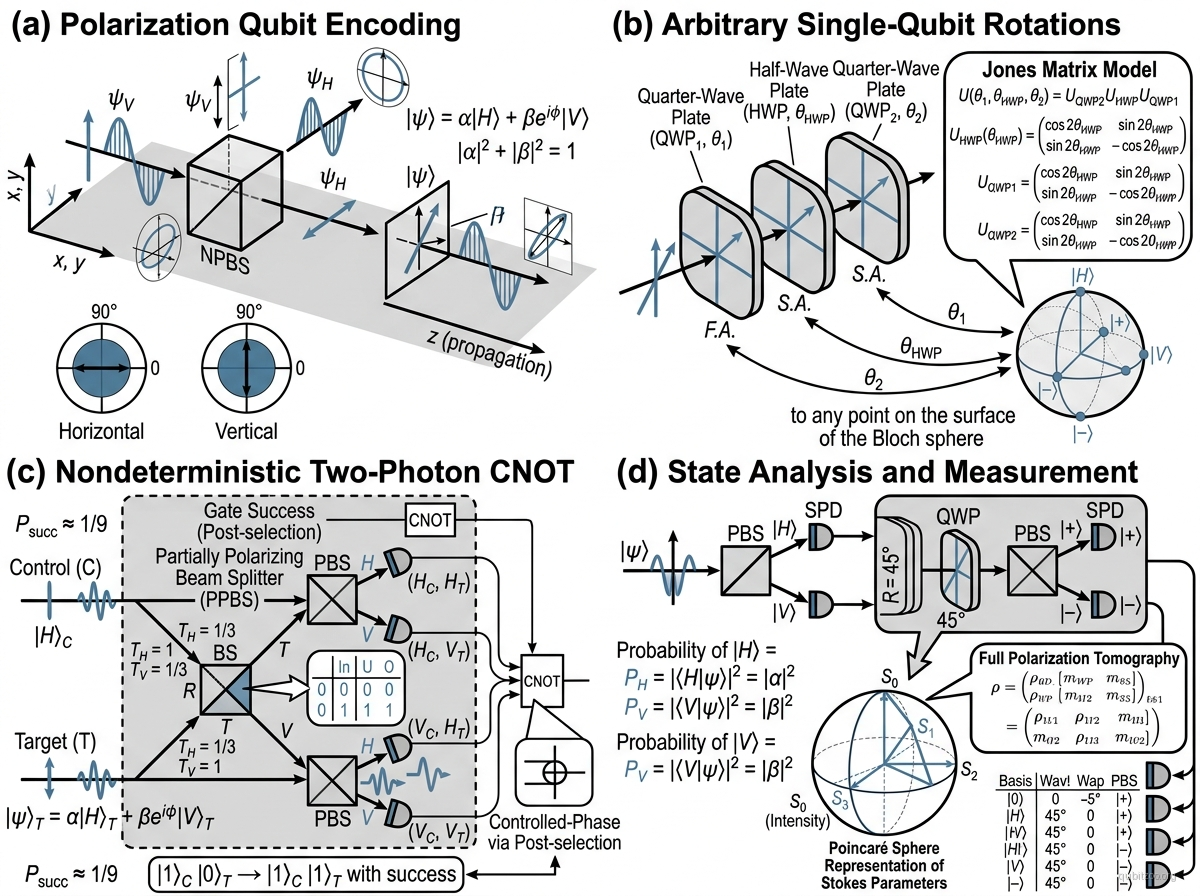
A polarization photonic qubit encodes a two-level state in orthogonal polarization modes of one photon,
Waveplates or integrated birefringent elements implement arbitrary single-qubit rotations, while polarizing beam splitters provide state analysis. Polarization is the most direct free-space photonic encoding and is ubiquitous in entanglement distribution and quantum communication. Its principal weakness is uncontrolled birefringence in fibres and integrated waveguides; time-bin and frequency-bin encodings often travel more robustly.
Hamiltonian and Control
Any lossless polarization transformation is an rotation,
implemented optically with retarders or polarization-preserving integrated circuits. Two-photon entangling gates are usually measurement-induced: Hong-Ou-Mandel interference plus polarization-dependent beam splitting realizes a nondeterministic CNOT.
Motivation
- Encode a qubit in a degree of freedom that is simple to prepare, transform, and measure.
- Interface naturally with entangled-photon sources, quantum memories, and free-space links.
- Avoid path duplication for many single-qubit operations.
Experimental Status
Polarization qubits are a mature quantum-communication encoding. Crespi et al. demonstrated the first integrated polarization-encoded CNOT in 2011 using laser-written partially polarizing directional couplers, with logical-basis fidelity and process fidelity .
Key Metrics
| Metric | Value | Notes | Fidelity reference |
|---|---|---|---|
| CNOT truth-table fidelity | 0.940 ± 0.004 | Integrated polarization gate | Crespi et al. 2011 |
| CNOT process fidelity | 0.906 ± 0.003 | Quantum process tomography | Crespi et al. 2011 |
| Bell-state discrimination probability | 0.877 ± 0.007 | Same integrated device | Crespi et al. 2011 |
Scaling Considerations
- Fibre birefringence and polarization-mode dispersion demand active compensation.
- Integrated circuits must preserve both polarization modes with matched loss and phase.
- Deterministic photon-photon interactions remain absent; scalable computing relies on ancillas, feed-forward, cluster states, or fusion.
References
- A. Crespi et al., “Integrated photonic quantum gates for polarization qubits,” Nature Communications 2, 566 (2011).
Linked Papers
Evergreen context
- erasure-error-vs-pauli-error — photon loss is often detectable and should not be modeled as an anonymous Pauli error.
- threshold-theorem — explains why probabilistic gates require architectural overhead rather than invalidating scalability outright.
- coherence-time-hierarchy — decoherence is dominated by environment-induced birefringence and polarization-mode dispersion, which drive differential phase drift between and ; this is a dephasing problem, not a relaxation problem, and is why time-bin transport outlasts polarization on long fibers.
- noise-bias-and-asymmetric-error-channels — uncontrolled birefringence biases the residual in-codespace error toward a -like phase channel in the / basis while photon loss remains a separate flagged erasure, giving a naturally asymmetric error model.
Related Entries
- time-bin-photonic-qubit — more robust for long fibre links.
- dual-rail-photonic-qubit — path-mode encoding favored in integrated LOQC.
- frequency-bin-photonic-qubit — spectral-mode encoding compatible with electro-optic processing.