 Qubit Zoo
Figure
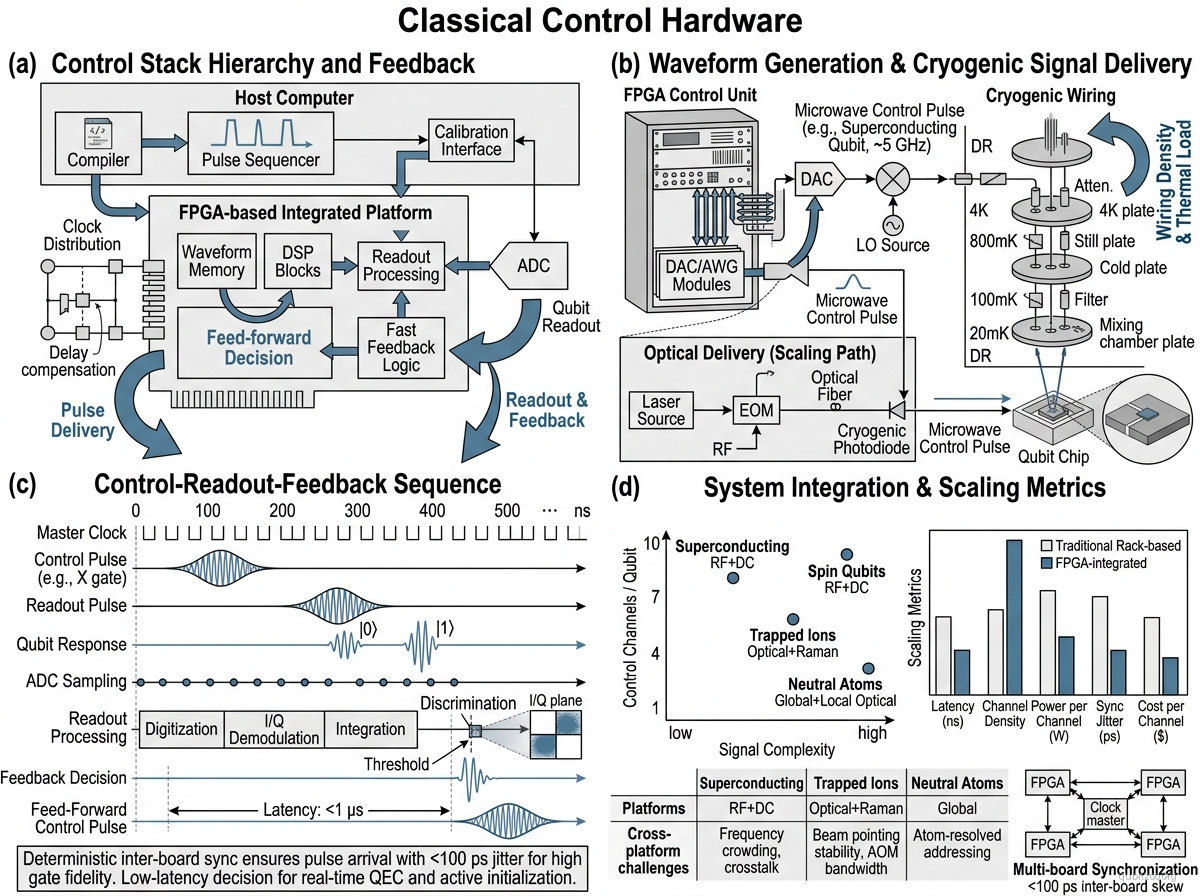
Description
Classical control hardware encompasses the room-temperature and intermediate-stage electronics that generate, shape, route, and synchronize the signals used to manipulate qubits. Every qubit platform requires precision classical control; it is often the practical bottleneck for scaling quantum processors beyond hundreds of qubits.
Qubit operations (gates, initialization, dynamical decoupling, readout, and mid-circuit feedback) require precisely timed analog and digital signals delivered to the quantum processor. Classical control systems translate a compiled quantum program into physical waveforms — microwave and flux pulses for superconducting qubits, laser pulses for trapped ions and neutral atoms, and voltage or RF pulses for spin qubits. Required timing precision is platform- and operation-dependent; modern RFSoC systems span sub-nanosecond pulse-duration resolution, nanosecond-scale event timing, and sub-microsecond feedback loops.
Rack-based (traditional): Separate instruments (AWGs, microwave sources, digitizers, and local oscillators) connected by cables. This architecture is flexible but bulky, and dedicated control, bias, and readout paths create a wiring and thermal-load problem as channel count grows.
FPGA/RFSoC-based integrated platforms: Custom boards combine waveform generation, direct-RF DAC/ADC channels, sequencing, readout digitization, digital signal processing, and real-time feedback in programmable logic. Open-source examples include QICK and FIREQ. Multi-board systems such as XCOM add deterministic clock alignment and low-latency all-to-all communication.
Cryogenic and optical delivery: Moving signal generation or conversion into the cryostat can reduce room-temperature cabling, but it introduces strict power-dissipation, noise, and thermalization constraints. Monarkha et al. (2026) delivered modulated light over telecom fiber to a photodiode at the 1 K stage and found no measurable transmon-coherence degradation relative to an all-microwave input line over repeated 20-hour runs. Liu et al. (2026) demonstrated a separate all-digital superconducting controller directly interconnected with a qubit at 10 mK.
Hamiltonian / Control Model
Classical-control hardware is not a qubit modality and therefore has no unique microscopic Hamiltonian. For a representative microwave-controlled two-level system, however, the controller implements the rotating-frame drive Hamiltonian
where is the qubit-drive detuning and , are the calibrated in-phase and quadrature envelopes synthesized by the DAC/direct-RF chain. A real signal path has an impulse response , so the delivered complex envelope is
Calibration and digital predistortion seek an inverse filter such that , while respecting DAC bandwidth, quantization, latency, and stability constraints. Optical and voltage-controlled platforms use different carriers and microscopic couplings, but the same systems problem remains: synthesize a commanded control field, deliver it through a nonideal transfer chain, digitize the measurement return, and condition the next operation on the result.
Motivation
- Every qubit platform requires classical control — it is a universal infrastructure dependency.
- Wiring density is a critical scaling bottleneck: superconducting and spin-qubit systems can require multiple control, bias, and readout paths per device, making connector density and thermal load increasingly difficult at large scale.
- Synchronization across multi-board systems requires a shared clock, calibrated deterministic delays, and low-latency communication. XCOM demonstrated drift-free alignment of QICK execution clocks to within 100 ps and communication latency below 185 ns; this is clock alignment/skew, not a universal jitter requirement.
- Real-time processing for error correction and mid-circuit feedback must close the loop within the hardware’s measurement and QEC-cycle budget. Yang et al. (2026) experimentally demonstrated a 550 ns closed loop, including 124 ns of neural-network decoding, within a 1.25 s superconducting surface-code cycle.
- Cryogenic integration (cryo-CMOS, SFQ logic) could reduce wiring by moving some control electronics to 4K or lower stages, but introduces power dissipation and noise constraints.
Experimental Status
Open-source RFSoC control — Stefanazzi et al. (2022):
- QICK combined an RFSoC FPGA, firmware, software, and an optional analog front end for direct synthesis of control pulses up to 6 GHz.
- Transmon benchmarking reported 99.93% average gate fidelity.
Deterministic multi-board control — Martin et al. (2026):
- XCOM synchronized the absolute execution clocks of QICK boards to within 100 ps without drift or loss of lock.
- The full-mesh network provided deterministic simultaneous data communication with latency below 185 ns.
Cryogenic signal delivery — Monarkha et al. and Liu et al. (2026):
- Optical-to-microwave control using a photodiode at 1 K produced no measurable coherence degradation relative to conventional microwave delivery over repeated 20-hour measurements.
- A superconducting controller at 10 mK reported 99.9% average Clifford fidelity, leakage of order , and estimated gate-operation energy of 0.121 fJ.
Closed-loop QEC — Yang et al. (2026):
- A hardware-integrated FPGA neural-network decoder demonstrated real-time distance-3 surface-code correction on a superconducting processor.
- The deterministic closed-loop latency was 550 ns, including 124 ns for decoding, within a 1.25 s QEC cycle.
Open-source QEC control stack — Liu et al. (2026):
- A three-board ZCU216 RFSoC prototype built on RISC-Q integrated pulse control, syndrome aggregation, network communication, decoding, and feedback distribution.
- The measured distance-3 decoding-feedback path took 446 ns. The prototype was hardware-tested but not coupled to a live qubit processor, so this is a control-stack latency result rather than an experimental QEC cycle.
- Sub-microsecond performance through distance 21 (about 881 physical qubits) was an extrapolation from measured subsystems, not a demonstrated processor-scale result.
Direct-RF control and calibration — La Capra et al. and Huszabianlou et al. (2026):
- FIREQ generated and acquired direct-RF signals up to 9.3 GHz, with 107 ps pulse-duration resolution and 1.7 ns event-timing resolution on a ZCU216 RFSoC.
- A QubiC fixed-point FIR/IIR predistortion cascade operated at a 500 MHz fabric clock for 1 GS/s flux lines and added 162 ns latency, making the control-transfer function an explicit hardware-design constraint.
Evergreen context
- quantum-hardware treats control electronics as part of the machine, not just lab scaffolding, because usable qubits only matter if compiled programs can reach them as calibrated, deterministic waveforms.
- divincenzo-criteria makes the dependency explicit: universal gates, reliable state preparation, and qubit-specific measurement all fail in practice if the classical stack cannot synthesize, synchronize, and condition the required signals.
- threshold-theorem turns classical latency into a fault-tolerance constraint, since mid-circuit measurement and decoder feedback are only useful if the control system can react before accumulated errors erase the syndrome value.
- coherence-time-hierarchy — classical control latency (waveform synthesis, measurement digitization, decoder processing) must fit within the coherence budget of the fastest qubit in the architecture; the hierarchy makes this dependency explicit by separating coherence into distinct timescales and noise floors.
Scaling Considerations
Cross-platform signal requirements
| Platform | Primary Control Signals | Key Challenges |
|---|---|---|
| Superconducting | Microwave pulses (4–8 GHz), flux bias DC/RF | Frequency crowding, crosstalk |
| Spin qubits | RF/microwave + DC gate voltages | Sub-mV voltage precision, charge noise |
| Trapped ions | Laser pulses (optical + Raman) | Beam pointing stability, AOM bandwidth |
| Neutral atoms | Global + local laser addressing | Atom-resolved control, rearrangement |
| Photonic | Electro-optic modulators, timing | Synchronization across probabilistic sources |
Scaling challenges
- Wiring density and thermal budget at each cryostat stage
- Deterministic synchronization across hundreds of control channels
- Sub-microsecond feedback latency for real-time QEC decoding
- Power dissipation constraints for cryogenic control electronics
- Cost and form factor reduction for commercial-scale systems
Key Metrics
| Metric | Value | Notes | Fidelity reference |
|---|---|---|---|
| Direct-RF synthesis | Up to 6 GHz | QICK RFSoC control output | Stefanazzi et al. 2022 |
| Demonstrated average gate fidelity | 99.93% | Transmon benchmark using QICK | Stefanazzi et al. 2022 |
| Multi-board clock alignment | Within 100 ps | Drift-free synchronization of QICK execution clocks | Martin et al. 2026 |
| Inter-board communication latency | ns | Deterministic all-to-all simultaneous XCOM messaging | Martin et al. 2026 |
| Closed-loop QEC latency | 550 ns | Includes 124 ns FPGA decoding inside a 1.25 s surface-code cycle | Yang et al. 2026 |
| Prototype QEC decoding-feedback latency | 446 ns | Three-board RISC-Q/RFSoC distance-3 control-stack prototype; not connected to a live qubit processor | Liu et al. 2026 |
| RFSoC pulse-duration resolution | 107 ps | FIREQ direct-RF generation to 9.3 GHz; event timing resolution 1.7 ns | La Capra et al. 2026 |
| Millikelvin controller fidelity | 99.9% average Clifford fidelity | 10 mK controller; estimated operation energy 0.121 fJ | Liu et al. 2026 |
| Real-time flux predistortion latency | 162 ns | Representative FIR/IIR cascade at 500 MHz for 1 GS/s flux lines | Huszabianlou et al. 2026 |
References
Control platforms
- L. Stefanazzi et al., “The QICK (Quantum Instrumentation Control Kit): Readout and control for qubits and detectors,” Rev. Sci. Instrum. 93, 044709 (2022) — arXiv:2110.00557
- D. Martin et al., “XCOM: Full Mesh Network Synchronization and Low-Latency Communication for QICK (Quantum Instrumentation Control Kit),” arXiv:2603.18977 (2026)
- G. La Capra et al., “FIREQ: FPGA Instrumentation for Readout and Qubit control,” arXiv:2608.29399 (2026)
- M. Huszabianlou et al., “Error-Bounded Fixed-Point Design of Super-Sample-Rate IIR Filters for Real-Time Superconducting Qubit Flux Predistortion,” arXiv:2609.16488 (2026)
Cryogenic delivery and feedback
- V. Monarkha et al., “Comparing optical-microwave conversion and all-microwave control schemes for a transmon qubit,” arXiv:2603.18780 (2026)
- K. Liu et al., “A plug-and-play superconducting quantum controller at millikelvin temperatures enables exceeding 99.9% average gate fidelity,” arXiv:2604.05693 (2026)
- X. Yang et al., “Real-time Surface-Code Error Correction Using an FPGA-based Neural-Network Decoder,” arXiv:2605.04892 (2026)
- J. Liu et al., “A Scalable Open-Source QEC System with Sub-Microsecond Decoding-Feedback Latency,” arXiv:2603.16203 (2026)
Linked Papers
- martin-2026-xcom-full-mesh-network
- monarkha-2026-comparing-optical-microwave-conversion-and
- liu-2026-a-plug-and-play-superconducting-quantum
- stefanazzi-2022-qick-instrumentation-control
- berritta-2026-adaptive-spectroscopy-of-fast
- wegmann-2026-zero-g-a-pre-decoder-aware-decoder
- capra-2026-fireq-fpga-instrumentation-for
- huszabianlou-2026-error-bounded-fixed-point-design-of
- yang-2026-real-time-surface-code-error-correction
- liu-2026-scalable-open-source-qec-system
Related Entries
- cryogenic-amplification — cryogenic signal chain for qubit readout
- qubit-readout — measurement infrastructure
- quantum-transduction — optical-to-microwave conversion for networking