 Qubit Zoo
Figure
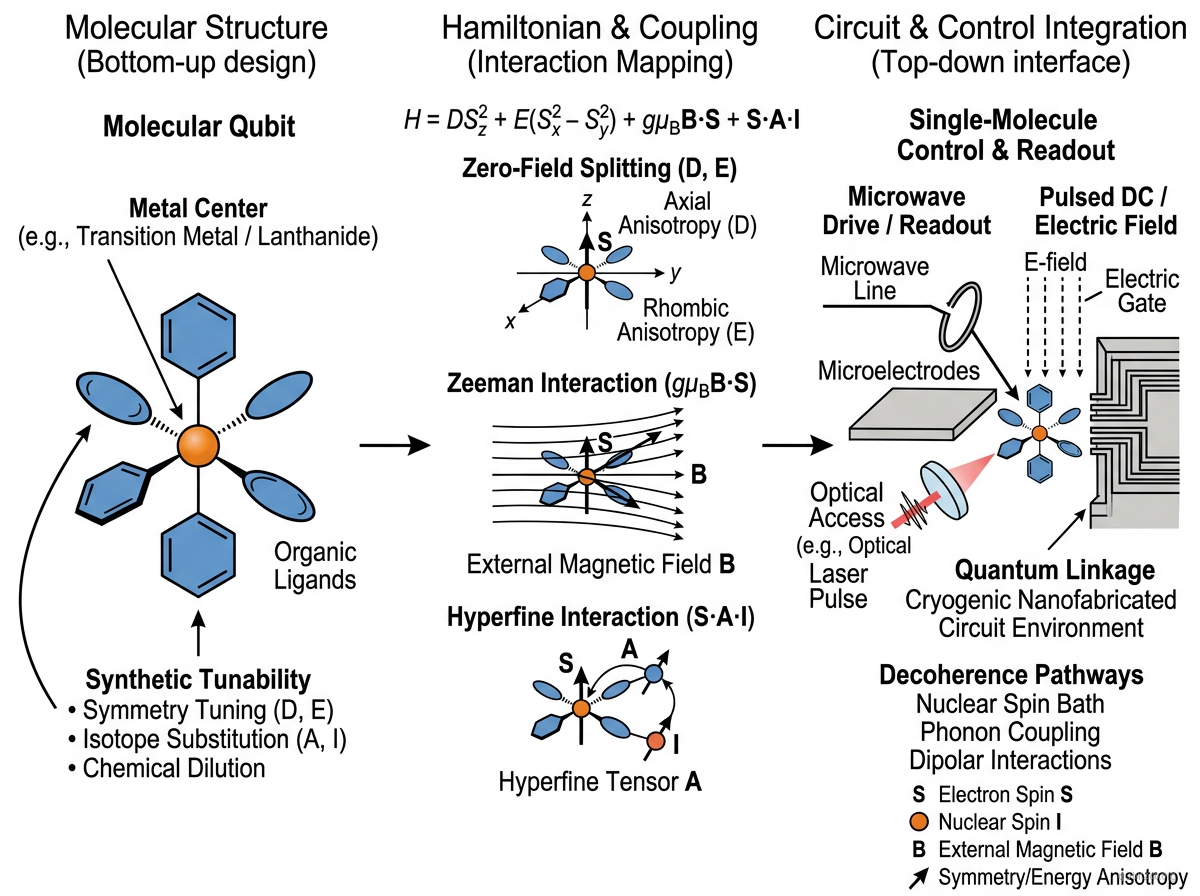
Description
Molecular qubits encode quantum states in the electronic or nuclear spin degrees of freedom of chemically defined molecules—often transition-metal coordination complexes such as V(IV), Cu(II), Cr(III), or Fe phthalocyanines, and sometimes lanthanide complexes such as Tb(III) or Ho(III). Chemical synthesis provides bottom-up control of anisotropy, spin-orbit coupling, hyperfine structure, and the local vibrational and nuclear-spin environment.
The qubit Hamiltonian can therefore be engineered at synthesis time. Ligand design, isotope choice, local symmetry, dilution, and clock-transition engineering provide complementary routes to tune control matrix elements and suppress decoherence. For systems, zero-field splitting vanishes and the leading terms are Zeeman and hyperfine interactions; for , crystal-field anisotropy creates additional addressable levels and avoided crossings.
This entry concerns chemically synthesized molecular spin qubits. It is distinct from ultracold polar-molecule qubits, which encode information in rotational/hyperfine states of optically trapped molecules and use electric dipole-dipole exchange. It is also distinct from a single molecule used only as the weak link of a superconducting circuit.
Hamiltonian
A conventional effective spin Hamiltonian for a molecular-spin complex is
where and are the axial and rhombic zero-field-splitting parameters, is the generally anisotropic electronic tensor, and couples the electron spin to nuclear spin . The omitted nuclear-Zeeman and higher-order crystal-field terms can matter in precision spectroscopy but are usually smaller than the displayed electronic terms. For a fixed-spin manifold, subtracting changes only the energy origin; it also makes explicit that the rank-two zero-field-splitting terms vanish for .
After selecting an isolated doublet and moving to its eigenbasis, resonant control reduces to the usual driven-qubit form
with and the drive matrix element inherited from the full molecular Hamiltonian and the chosen magnetic- or electric-field coupling mechanism.
Motivation
Molecular qubits offer a distinct advantage over lithographic platforms: synthetic tunability at the molecular level. This bridges quantum information with chemistry and materials design, enabling:
- Bottom-up Hamiltonian engineering through ligand, isotope, and symmetry choice
- Potential dense integration through self-assembly and crystallization
- Complementary anisotropy/coherence tradeoffs between lanthanide and transition-metal families
- Local electric control and switchable interactions at the single-molecule scale
- A natural platform for hybrid quantum sensing and spin-photon architectures
Experimental Status
Milestone coherence — Zadrozny et al. (2015):
- Measured a Hahn-echo coherence time in a chemically tunable V(IV) coordination complex, establishing that ligand and nuclear-spin engineering can produce millisecond-scale ensemble coherence.
Coupled molecular dimers — Ardavan et al. (2015):
- Constructed coupled CrNi molecular-spin dimers while retaining phase coherence.
- For one dimer, the reported exceeded the interaction timescale , supporting chemically engineered two-qubit operations, although no randomized-benchmarking gate fidelity was reported.
Room-temperature optical control — Mena et al. (2024):
- Demonstrated optically detected coherent control of photoexcited pentacene triplet spins at room temperature in both a molecular crystal and a thermally evaporated film.
- Reported photoluminescence contrast above and microsecond-scale coherence, establishing an ambient molecular spin–optical interface for sensing-oriented operation.
Single-molecule ferrimagnet — Huang et al. (2025):
- Used ESR-STM to coherently control a mixed-spin FePc–Fe(CH) molecular ferrimagnet with a protected ground-state doublet.
- Measured a single-molecule spin lifetime up to and demonstrated controllable ferro- and antiferromagnetic intermolecular coupling.
All-electrical local control — Greule et al. (2026):
- Demonstrated exchange-mediated spin-electric control of individual FePc and coupled Fe–FePc complexes.
- Observed nonlinear resonance shifts approaching near a molecular orbital and used voltage detuning in coherent Rabi-control experiments on single and coupled molecular spins.
Current limits:
- Ensemble coherence records, single-molecule lifetimes, and coupled-dimer interaction times probe different regimes and should not be compared as a single performance leaderboard.
- Scalable initialization, calibrated two-qubit gates, and high-fidelity single-molecule readout remain open integration bottlenecks.
Key Metrics
| Metric | Value | Notes | Fidelity reference |
|---|---|---|---|
| Hahn-echo | Diluted V(IV) coordination complex; ensemble pulsed EPR | Zadrozny et al. 2015 | |
| Coupled-dimer timescales | ; | CrNi dimer 1A; interaction supports a two-qubit gate timescale but is not a measured gate fidelity | Ardavan et al. 2015 |
| Room-temperature optical contrast | Optically detected Rabi control of photoexcited pentacene triplets in crystal and thin film | Mena et al. 2024 | |
| Single-molecule | Up to | FePc–Fe(CH) ferrimagnet measured by ESR-STM | Huang et al. 2025 |
| Electrical ESR tuning | – | Nonlinear exchange-mediated shift near the FePc LUMO; coherent voltage detuning demonstrated | Greule et al. 2026 |
References
Original proposal
- M. N. Leuenberger and D. Loss, “Quantum computing in molecular magnets,” Nature 410, 789–793 (2001) — arXiv:cond-mat/0011415
Experimental demonstrations
- J. M. Zadrozny et al., “Millisecond Coherence Time in a Tunable Molecular Electronic Spin Qubit,” ACS Cent. Sci. 1, 488–492 (2015)
- A. Ardavan et al., “Engineering coherent interactions in molecular nanomagnet dimers,” npj Quantum Inf. 1, 15012 (2015) — arXiv:1510.01694
- A. Mena et al., “Room-Temperature Optically Detected Coherent Control of Molecular Spins,” Phys. Rev. Lett. 133, 120801 (2024) — arXiv:2402.07572
- W. Huang et al., “Quantum spin-engineering in on-surface molecular ferrimagnets,” Nat. Commun. 16, 5208 (2025) — arXiv:2410.18563
- P. Greule et al., “Exchange-mediated spin–electric control of single molecules on surfaces,” Nat. Phys. (2026) — arXiv:2507.13699
Reviews and design principles
- A. Gaita-Ariño et al., “Molecular spins for quantum computation,” Nat. Chem. 11, 301–309 (2019)
- J. J. Baldoví et al., “Design of Magnetic Polyoxometalates for Molecular Spintronics and as Spin Qubits,” Adv. Inorg. Chem. 69, 213–249 (2017)
Linked Papers
- leuenberger-2001-quantum-computing-molecular-magnets
- zadrozny-2015-millisecond-coherence-time
- ardavan-2015-coherent-molecular-nanomagnet-dimers
- mena-2024-room-temperature-optical-molecular-spin-control
- huang-2025-on-surface-molecular-ferrimagnets
- greule-2026-spin-electric-control-molecules
- gaitaario-2019-molecular-spins-computation
- baldov-2017-design-magnetic-polyoxometalates
Evergreen context
- coherence-time-hierarchy — molecular platforms are best compared through how chemistry reshapes and , especially by suppressing nuclear-spin and vibrational noise rather than by changing the logical encoding itself.
- spin-orbit-coupling-for-qubit-control — ligand-field engineering lets molecular qubits tune the same core tradeoff seen in hole-spin platforms: stronger spin-orbit structure can enable richer control, but it also opens extra dephasing channels.
- divincenzo-criteria — synthetic tunability helps with well-defined qubits and coherence engineering, but scalable two-qubit coupling and high-fidelity single-molecule readout are still the criteria that keep the platform exploratory.
Related Entries
- polar-molecule-qubit — ultracold tweezer-trapped molecules using rotational/hyperfine states and dipolar exchange, rather than chemically synthesized molecular spins.
- nv-center-qubit — solid-state spin qubit with related coherence and single-spin readout strategies.
- spin-qubit — semiconductor spin qubit with complementary lithographic control and coupling mechanisms.
- qubit-readout — single-molecule initialization and readout remain central scaling bottlenecks.