 Qubit Zoo
Figure
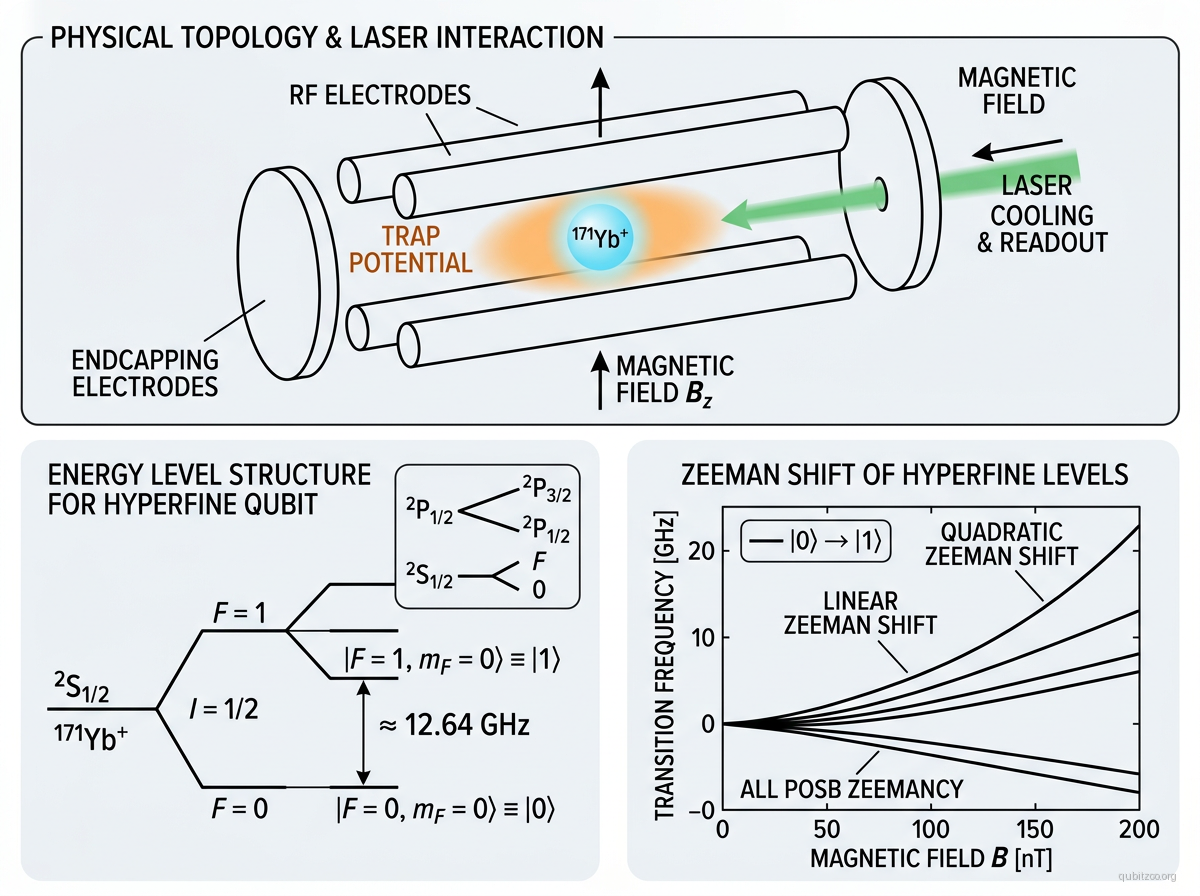
Description
The ytterbium-171 hyperfine qubit encodes quantum information in the two hyperfine clock states of the ion’s ground-state manifold: and , separated by 12.642812 GHz. Both states have , making the qubit first-order insensitive to magnetic field fluctuations — the transition frequency shifts only quadratically with field, enabling exceptionally long coherence times.
The ion has nuclear spin and no electronic angular momentum in the ground state (), yielding the simplest possible hyperfine structure: just four ground states. This simplicity, combined with convenient photoionization loading and state-dependent fluorescence detection on the cycling transition at 369.5 nm, makes it the workhorse qubit for multiple trapped-ion quantum computing platforms including Quantinuum (H-series processors) and IonQ.
Two-qubit entangling gates are performed via the Coulomb-mediated motional bus using either Raman transitions (stimulated Raman with 355 nm pulsed laser) or microwave-driven schemes. Gate fidelities exceeding 99.9% have been demonstrated (Ballance et al. 2016, Gaebler et al. 2016).
Hamiltonian
The ground-state hyperfine Hamiltonian is:
where is the magnetic dipole hyperfine constant, is the nuclear spin, and is the electronic angular momentum. For with , this gives a splitting:
In an external magnetic field , the clock-state transition frequency has only a second-order Zeeman shift:
where , providing excellent field insensitivity.
Motivation
Trapped-ion qubits require long coherence times and high-fidelity operations to serve as building blocks for fault-tolerant quantum computing. Hyperfine clock states in provide first-order magnetic field insensitivity without active stabilization, coherence times exceeding 10 minutes, and a microwave-frequency splitting compatible with high-stability oscillators. The simple level structure and efficient state detection make the most widely deployed trapped-ion qubit platform.
Experimental Status
First characterization — Olmschenk et al. (2007):
- Demonstrated manipulation and detection of a trapped hyperfine qubit
- Characterized state preparation, single-qubit gates, and state-dependent fluorescence readout
- Established the system as a viable qubit platform
High-fidelity two-qubit gates — Ballance et al. (2016):
- Achieved 99.9(1)% two-qubit gate fidelity using light-shift gates on hyperfine qubits
- Oxford group demonstration using geometric phase gates
High-fidelity gate set — Gaebler et al. (2016):
- Demonstrated a high-fidelity universal gate set for with amplitude-modulated Mølmer-Sørensen gates
- Methods directly applicable and transferred to platforms
Long coherence — Wang et al. (2021):
- Single ion qubit with estimated coherence time exceeding one hour using dynamical decoupling sequences
- Demonstrated the extraordinary coherence potential of clock-state encodings
System-level deployment — Quantinuum H2 (2024):
- 56-qubit fully connected register
- System-level two-qubit gate fidelities of 99.8%
- Mid-circuit measurement and qubit reuse demonstrated, enabling real-time quantum error correction
Key Metrics
| Metric | Value | Notes | Fidelity reference |
|---|---|---|---|
| >10 s | Radiative lifetime of ground state; effectively infinite | — | |
| (echo) | >10 min | With dynamical decoupling sequences | Wang et al. 2021 |
| 1–10 s | Limited by magnetic field fluctuations | Olmschenk et al. 2007 | |
| Hyperfine splitting | 12.642812 GHz | Clock transition, first-order field insensitive | Olmschenk et al. 2007 |
| 1Q gate fidelity | 99.99%+ | Randomized benchmarking | Gaebler et al. 2016 |
| 2Q gate fidelity | 99.9% | Light-shift and MS gates | Ballance et al. 2016 |
| SPAM fidelity | 99.93% | Electron shelving detection | Noek et al. 2013 |
| Gate time (1Q) | 1–10 μs | Microwave or Raman driven | Olmschenk et al. 2007 |
| Gate time (2Q) | 30–600 μs | Depends on gate scheme and ion number | Gaebler et al. 2016 |
| Operating temperature | ~4 K (trap) | Room-temperature vacuum; ions laser-cooled to ~mK | — |
References
Original characterization
- S. Olmschenk et al., “Manipulation and detection of a trapped Yb⁺ hyperfine qubit,” Phys. Rev. A 76, 052314 (2007)
High-fidelity gates
- C. J. Ballance et al., “High-Fidelity Quantum Logic Gates Using Trapped-Ion Hyperfine Qubits,” Phys. Rev. Lett. 117, 060504 (2016)
- J. P. Gaebler et al., “High-Fidelity Universal Gate Set for ⁹Be⁺ Ion Qubits,” Phys. Rev. Lett. 117, 060505 (2016)
Coherence
- P. Wang et al., “Single ion qubit with estimated coherence time exceeding one hour,” Nat. Commun. 12, 233 (2021)
SPAM
- R. Noek et al., “High speed, high fidelity detection of an atomic hyperfine qubit,” Opt. Express 21, 21449 (2013)
Linked Papers
- olmschenk-2007-yb171-qubit
- ballance-2016-ion-gate-fidelity
- gaebler-2016-ms-gate
- noek-2013-high-speed-detection
- sorensen-1999-ms-gate
- wang-2017-single-qubit-quantum-memory
- wang-2021-single-ion-qubit
Evergreen context
- coherence-time-hierarchy — clock-state Yb is the cleanest example of a qubit whose practical value comes from enormous separation, not raw gate speed
- motional-mode-coupling-in-ion-traps — Yb hyperfine qubits still rely on the shared phonon bus for entangling operations, whether Raman or microwave assisted
- divincenzo-criteria — helps explain why Yb became the commercial workhorse: initialization, measurement, long coherence, and a mature entangling-gate stack all land in one species
Related Entries
- trapped-ion-qubit — parent platform
- cirac-zoller-gate — foundational trapped-ion gate proposal
- molmer-sorenson-gate — dominant modern entangling gate for the Yb hyperfine stack