 Qubit Zoo
Figure
Description
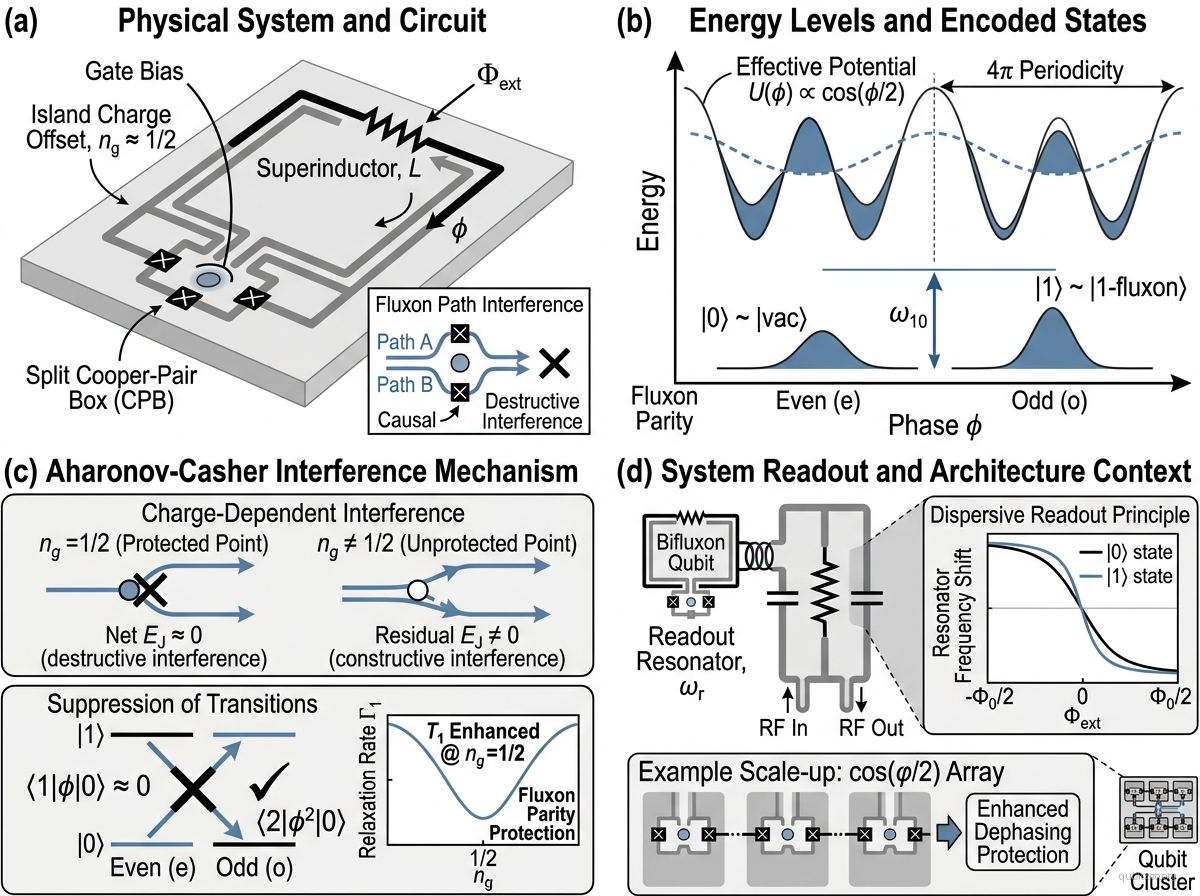
The bifluxon qubit is a fluxon-parity-protected superconducting qubit based on Aharonov-Casher interference. Its loop contains a split Cooper-pair box—two Josephson junctions separated by a small island—in series with a superinductor. The logical states occupy the even- and odd-fluxon sectors of that loop.
When the island offset charge is one electron modulo ( in Cooper-pair units), the two paths for a single fluxon to cross the split junction interfere destructively. Single-fluxon tunnelling is then forbidden in the symmetric-junction limit, while double-fluxon tunnelling remains allowed. The resulting low-energy dynamics are equivalent to a -periodic, Josephson element. Even- and odd-parity logical wavefunctions occupy disjoint sets of wells near , suppressing relaxation matrix elements. Delocalization within each parity sector can additionally reduce flux-noise dephasing.
This is symmetry protection in a two-dimensional circuit Hilbert space, not a literal single-junction device. Junction asymmetry restores a residual single-fluxon amplitude, charge offsets must remain near the interference point, and the demonstrated first-generation device did not yet realize full dephasing protection.
Hamiltonian
With the high-frequency common mode eliminated, Kalashnikov et al. write the two-dimensional circuit Hamiltonian in the island-charge basis as
where counts Cooper pairs on the island, , is the island charging energy, is the charging energy of the superinductor mode, and . The loop phase is and .
At , the charge-sector symmetry makes the single-phase-slip matrix element vanish between adjacent fluxon wells. That selection rule is the origin of the effective periodicity; replacing the full Hamiltonian by an ordinary one-dimensional fluxonium potential would miss the interference mechanism. Junction imbalance adds the leading symmetry-breaking term (after the common mode is frozen).
Motivation
The central challenge in superconducting quantum computing is decoherence from environmental noise, primarily charge noise and flux noise. Conventional qubits (transmon, fluxonium) are protected against one noise type by operating at sweet spots, but remain vulnerable to the other. The bifluxon offers a path to simultaneous protection against both noise channels through a topological mechanism (fluxon-parity encoding) rather than materials engineering. If the protection can be scaled up — for instance, by replacing the single junction with arrays of elements — the bifluxon could achieve coherence times orders of magnitude beyond current transmon levels, potentially exceeding the threshold for quantum error correction with much lower overhead.
Experimental Status
First demonstration — Kalashnikov et al. (2020):
- Fabricated a bifluxon circuit with a CPB shunted by a granular aluminum superinductor.
- Demonstrated tenfold increase in energy relaxation time ( up to 100 μs) when the offset charge was tuned from the unprotected point to the charge-parity sweet spot.
- Inferred a lower bound for charge-noise-induced pure dephasing; the protected-state Ramsey measurement was limited by gate-pulse jitter, so this was not a record.
- Confirmed the Aharonov-Casher protection mechanism by observing the charge-dependent oscillation of .
- Published in PRX Quantum 1, 010307 (2020).
Related bifluxon-tunnelling fluxonium — Ardati et al. (2024):
- Demonstrated a simpler fluxonium realization in which resonant phase slips couple equal-parity fluxon wells at zero applied flux.
- Measured and Hahn-echo at an approximately 3 GHz qubit transition.
- This is a partially protected fluxonium implementation, not the split-CPB Aharonov-Casher circuit of the 2020 bifluxon experiment.
Key Metrics
| Metric | Value | Notes | Fidelity reference |
|---|---|---|---|
| (protected) | ~100 μs | At charge-parity sweet spot | Kalashnikov et al. 2020 |
| (unprotected) | ~10 μs | Away from sweet spot | Kalashnikov et al. 2020 |
| lower bound (split-CPB bifluxon) | 1 μs | Protected-state Ramsey bound; limited by gate-pulse jitter | Kalashnikov et al. 2020 |
| (bifluxon-tunnelling fluxonium) | 177 ± 3 μs | Zero-flux, partially protected fluxonium realization | Ardati et al. 2024 |
| (bifluxon-tunnelling fluxonium) | 75 ± 5 μs | Hahn echo in the same 2024 device | Ardati et al. 2024 |
| ~1 | CPB regime (charge-sensitive) | Kalashnikov et al. 2020 | |
| ≪1 | Large superinductance required | Kalashnikov et al. 2020 |
Scaling Considerations
- Superinductor quality: the 2020 split-CPB prototype had fitted , corresponding to . Its modelling estimated that the strong-delocalization regime needed for full flux-dephasing protection would require an ultrahigh-impedance superinductor with and a self-resonance above 1 GHz. A distinct 2024 bifluxon-tunnelling fluxonium device used .
- Charge stability: the protection mechanism requires stable tuning to the odd-charge parity point. Charge jumps (quasiparticle poisoning) can move the system away from the sweet spot, temporarily disabling protection.
- Gate implementation: universal gates on a protected qubit are inherently difficult because the same protection that suppresses noise also suppresses intentional control signals. Proposals include using the charge degree of freedom for gates and flux for gates, but experimental gate demonstrations are still pending.
- arrays: the demonstration proposes combining several split-CPB elements to enhance dephasing protection, but this adds fabrication and control complexity.
- Comparison to alternatives: the 0-π qubit and qubit pursue related protection goals with different circuit symmetries. The bifluxon uses a split CPB plus one superinductive branch, but remains sensitive to junction asymmetry and quasiparticle-induced charge-parity changes.
References
Proposal and demonstration
- K. Kalashnikov et al., “Bifluxon: Fluxon-Parity-Protected Superconducting Qubit,” PRX Quantum 1, 010307 (2020) | arXiv:1910.03769
Related modern realization
- W. Ardati et al., “Using Bifluxon Tunneling to Protect the Fluxonium Qubit,” Physical Review X 14, 041014 (2024) | arXiv:2402.04495
Linked Papers
Evergreen context
- josephson-junction-as-nonlinear-element — the split CPB supplies the two phase-slip paths whose interference protects fluxon parity.
- charge-noise-sweet-spot — explains why the odd-charge operating point is useful and why charge-parity jumps remain dangerous.
- noise-bias-and-asymmetric-error-channels — frames the distinction between suppressing relaxation and achieving full dephasing protection.
Related Entries
- fluxonium — related circuit topology with superinductive shunt
- 0-pi-qubit — alternative protected qubit using circuit symmetry
- cos2phi-qubit — alternative protected qubit with doubled Josephson potential
- ferbo-qubit — another protected superconducting qubit design
- heavy-fluxonium-qubit — fluxonium variant with enhanced protection