 Qubit Zoo
Figure
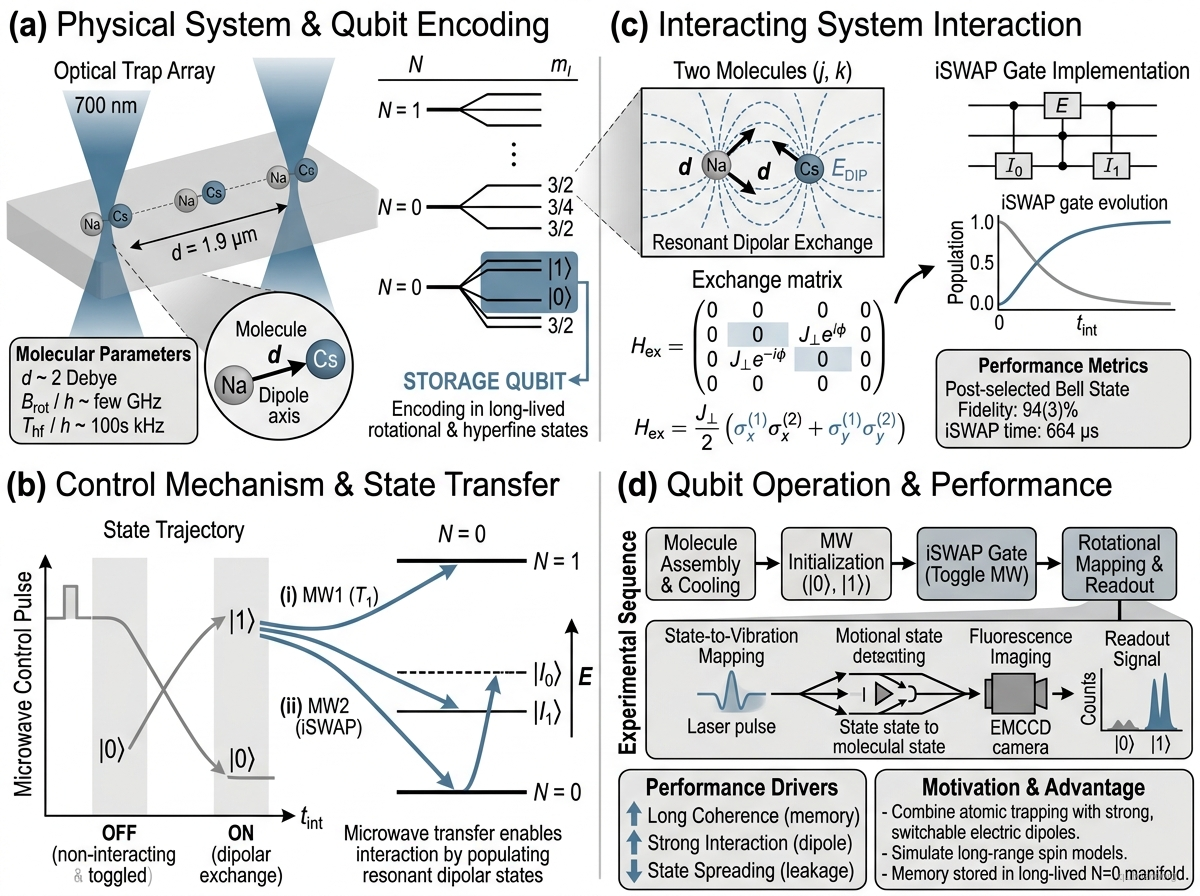
Description
A polar-molecule qubit encodes information in rotational and hyperfine states of an individually trapped ultracold molecule. Long-lived hyperfine states in the rotational ground manifold provide storage, while a rotationally excited state turns on an electric dipole-dipole exchange interaction between nearby molecules. This separates memory from interaction without changing particles.
The platform is distinct from chemically synthesized molecular spin qubits: here intact diatomic molecules such as NaCs are assembled and trapped in optical tweezers, individually addressed, and coupled through their permanent electric dipoles.
Hamiltonian
For one molecule,
where is rotational angular momentum, resolves nuclear-spin sublevels, and the Stark term controls dipole character. Within an interacting two-state manifold, resonant dipolar exchange reduces to
which generates an iSWAP at the appropriate interaction time. Microwave transfer between storage and interacting states toggles .
Motivation
- Combine atomic-style coherence and single-particle trapping with intrinsically strong, switchable electric dipoles.
- Simulate long-range spin models and implement exchange gates without Rydberg excitation.
- Use rich rotational/hyperfine structure as a controllable qubit or qudit resource.
Experimental Status
DeMille proposed dipolar quantum computation with trapped polar molecules in 2002. Picard et al. later implemented a two-qubit iSWAP gate between individual NaCs molecules 1.9 μm apart, using a 664 μs interaction and producing a post-selected Bell state with 94(3)% fidelity.
Key Metrics
| Metric | Value | Notes | Fidelity reference |
|---|---|---|---|
| Bell-state fidelity | 94(3)% | Post-selected on both NaCs molecules being detected | Picard et al. 2025 |
| iSWAP interaction time | 664 μs | Molecules separated by 1.9 μm | Picard et al. 2025 |
| Storage encoding | Hyperfine states | Non-interacting states in the rotational ground manifold | Picard et al. 2025 |
Scaling Considerations
- Molecule assembly, motional ground-state cooling, and survival detection reduce usable duty cycle.
- Motion-rotation coupling and differential trapping shifts currently limit gate fidelity.
- The dense internal spectrum is a resource for control but creates leakage and calibration burden.
- Larger arrays require repeatable molecule formation and parallel microwave/optical addressing.
References
- D. DeMille, “Quantum Computation with Trapped Polar Molecules,” Phys. Rev. Lett. 88, 067901 (2002).
- Y. Bao et al., “Dipolar spin-exchange and entanglement between molecules in an optical tweezer array,” Science 382, 1138–1143 (2023) — arXiv:2211.09780.
- L. R. B. Picard et al., “Entanglement and iSWAP gate between molecular qubits,” Nature 637, 821–826 (2025).
Linked Papers
- demille-2002-polar-molecule-quantum-computation
- bao-2023-dipolar-spin-exchange-entanglement
- picard-2025-molecular-iswap
Evergreen context
- coherence-time-hierarchy — separates long-lived storage states from the shorter interaction and motional timescales.
- sqrt-swap-as-universal-gate — the dipolar exchange interaction naturally generates iSWAP-family entanglers.
- divincenzo-criteria — useful for separating compelling two-molecule physics from processor-scale readiness.
Related Entries
- molecular-qubit — chemically synthesized molecular spin qubits rather than ultracold tweezer-trapped molecules.
- neutral-atom-qubit — shares optical trapping and single-particle assembly but uses atomic rather than molecular internal structure.