 Qubit Zoo
Figure
Description
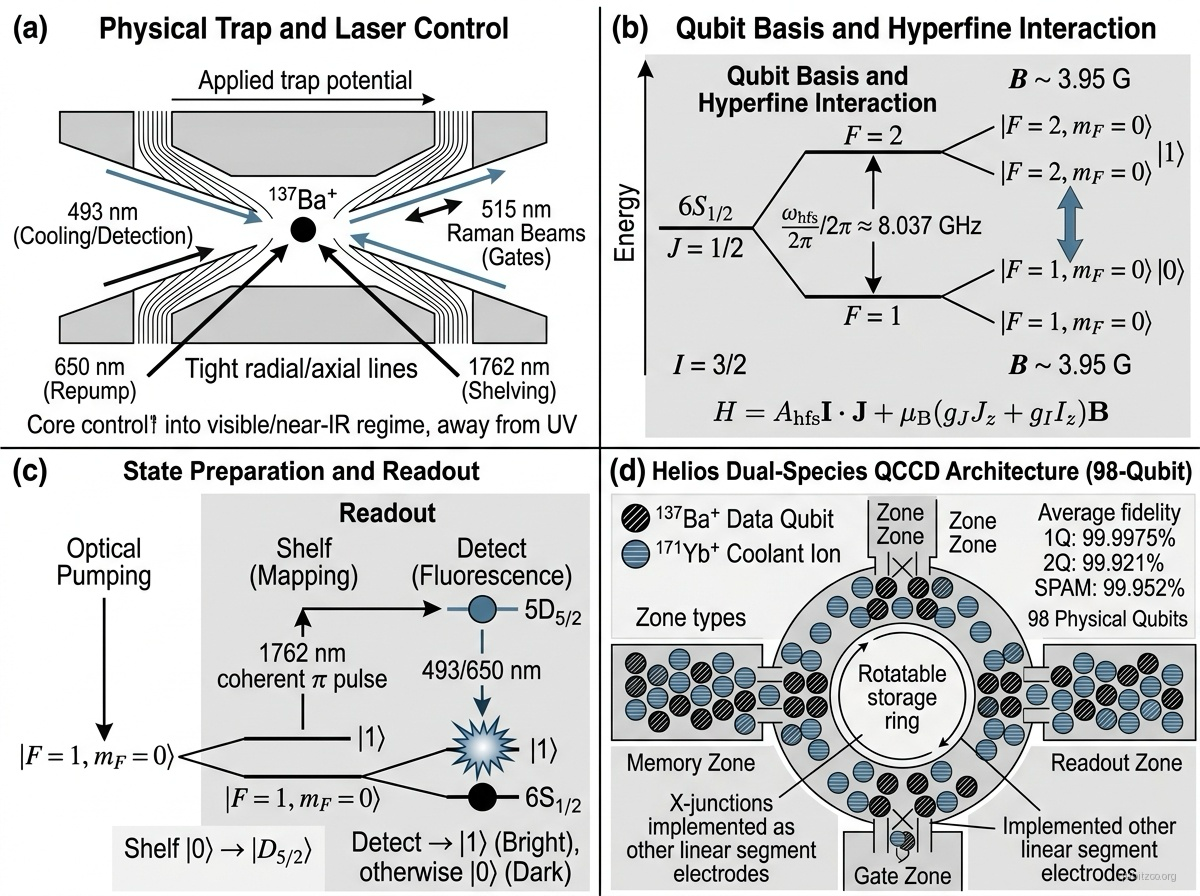
The barium-137 trapped-ion qubit encodes quantum information in the hyperfine manifold of the ground state of . With nuclear spin , the ground state splits into and hyperfine levels separated by . Both the 2010 single-ion demonstration and Quantinuum’s 2025 Helios processor define the qubit on the magnetically insensitive clock transition , with Helios taking and .
A major attraction of is its favorable laser stack for qubit control and readout. Fluorescence detection uses the 493 nm transition with 650 nm repumping from , while shelving and protected measurement use the narrow 1762 nm transition to the metastable manifold. In Helios, single- and two-qubit gates are driven by pairs of 515 nm Raman beams separated by the qubit splitting. Compared with ultraviolet-gated species, this pushes the core qubit-control optics into a more mature visible/near-IR regime with higher available laser power and reduced UV-induced optics degradation.
Quantinuum’s Helios processor made the first barium-based species deployed in a large-scale trapped-ion quantum computer. Helios is a 98-qubit QCCD processor with data qubits and co-trapped coolant ions for sympathetic recooling. Averaged over its operational zones, Helios reports single-qubit, two-qubit, and SPAM infidelities of , , and respectively, corresponding to fidelities of 99.9975%, 99.921%, and 99.952%. In 2026, the same Helios hardware was used to demonstrate encoded computations with 48 to 94 logical qubits using high-rate iceberg codes.
Hamiltonian
The relevant internal Hamiltonian is the hyperfine-plus-Zeeman Hamiltonian
where is the magnetic-dipole hyperfine constant, is the nuclear spin, is the electronic angular momentum, and is the applied bias field. For the ground state of ,
At zero field, the transition is a true clock transition with no first-order Zeeman shift. Helios operates instead at a finite bias field of about , where the qubit remains an approximate clock transition with second-order magnetic sensitivity; the paper quotes a second-order coefficient of at zero field. State preparation and measurement are implemented by coherently mapping the state into the metastable manifold with 1762 nm pulses, followed by fluorescence detection on the 493/650 nm cycling transitions.
Motivation
Barium offers an unusually attractive trapped-ion engineering point: the qubit species itself can be controlled and measured primarily with visible and near-IR light rather than relying on deep-UV qubit lasers. That improves component availability, eases power delivery, and reduces long-term UV damage to fibers and optics. The hyperfine clock transition also provides the standard trapped-ion virtues of long-lived ground-state storage and magnetic-field robustness.
The species is especially compelling inside a QCCD architecture. In Helios, serves as the data qubit while handles sympathetic cooling, separating computation from recooling and helping preserve qubit coherence during long, transport-heavy programs. The tradeoff is that the full dual-species machine still requires additional UV infrastructure for the ytterbium coolant, so the visible-wavelength advantage applies primarily to the qubit species and gate/readout stack rather than the entire system.
Experimental Status
First hyperfine-qubit demonstration — Dietrich et al. (2010):
- Demonstrated state preparation, microwave-driven qubit rotation, and shelving-based readout for a single ion.
- Implemented the ground-state hyperfine qubit on the 8.037 GHz clock transition.
- Used the 1762 nm transition for selective shelving and readout.
Large-scale processor deployment — Ransford et al. (2025):
- Introduced Helios, a 98-qubit QCCD processor using hyperfine qubits as data qubits.
- Co-trapped coolant ions provide sympathetic recooling with 369 nm light.
- Reported average infidelities of (1Q), (2Q), and (SPAM).
- Used a four-way X junction, rotatable storage ring, and 8 parallel operation zones for all-to-all connectivity via transport.
Encoded-computation milestone on Helios — Dasu et al. (2026):
- Demonstrated beyond-break-even encoded computations on the 98-qubit Helios processor using high-rate iceberg codes.
- Realized fault-tolerant and partially fault-tolerant benchmarks with between 48 and 94 logical qubits.
- Shows that the barium-based Helios platform is now supporting logical-layer as well as physical-qubit milestones.
Key Metrics
| Metric | Value | Notes | Fidelity reference |
|---|---|---|---|
| Hyperfine splitting | 8.037 GHz | $ | F=1,m_F=0\rangle \leftrightarrow |
| 1Q gate fidelity | 99.9975% | Helios zone-averaged benchmark | Ransford et al. 2025 |
| 2Q gate fidelity | 99.921% | Native / MS-family entangling benchmark on Helios | Ransford et al. 2025 |
| SPAM fidelity | 99.952% | From average infidelity | Ransford et al. 2025 |
| 1Q/2Q gate wavelength | 515 nm | Raman beam pairs separated by the qubit splitting | Ransford et al. 2025 |
| Cooling / detection | 493 nm | fluorescence transition | Dietrich et al. 2010 |
| Repump wavelength | 650 nm | Clears population from during fluorescence cycle | Dietrich et al. 2010 |
| Shelving wavelength | 1762 nm | Coherent mapping to the manifold for readout | Dietrich et al. 2010 |
| Bias field (Helios) | 3.95 G | Approximate clock-state operation point | Ransford et al. 2025 |
| Logical qubits demonstrated | 48–94 | High-rate iceberg-code benchmarks on Helios | Dasu et al. 2026 |
Scaling Considerations
- Visible/near-IR qubit optics: the barium qubit species moves gate, shelving, and fluorescence hardware away from deep-UV qubit lasers, improving component availability and reducing optics degradation.
- Not a fully UV-free computer: Helios still relies on sympathetic cooling at 369 nm, so the visible-wavelength advantage is species-specific rather than system-wide.
- Dual-species complexity: mixed-species loading, transport, recooling, and calibration add real overhead, even though they decouple cooling from computation.
- QCCD transport overhead: shuttling through junctions and between storage and logic zones trades wiring simplicity for transport scheduling, calibration burden, and clock-speed limits.
- Isotope logistics: is only about 11% naturally abundant, so isotope-selective loading or enriched sources remain operational considerations.
- Measurement complexity: the high-fidelity readout stack is powerful but nontrivial, involving coherent 1762 nm mapping pulses, fluorescence cycling, and crosstalk-mitigation protocols.
References
Qubit characterization
- M. R. Dietrich, N. Kurz, T. Noel, G. Shu, and B. B. Blinov, “Hyperfine and optical barium ion qubits,” Phys. Rev. A 81, 052328 (2010) | arXiv:1004.1161
Large-scale processor
- A. Ransford et al., “Helios: A 98-qubit trapped-ion quantum computer,” arXiv:2511.05465 (2025)
Logical-layer milestone
- S. Dasu et al., “Computing with many encoded logical qubits beyond break-even,” arXiv:2602.22211 (2026)
Linked Papers
- dietrich-2010-barium-hyperfine-qubit
- ransford-2025-helios-98-qubit
- dasu-2026-many-encoded-logical-qubits
Related Entries
- trapped-ion-qubit — parent platform
- ytterbium-hyperfine-qubit — alternative hyperfine ion species; Yb-171 serves as sympathetic coolant in Helios
- strontium-88-ion-qubit — another visible-wavelength trapped-ion species for comparison
- shuttling-ion-trap-qubit — QCCD architecture used by Helios
- molmer-sorenson-gate — entangling gate family used in Ba+ systems