 Qubit Zoo
Figure
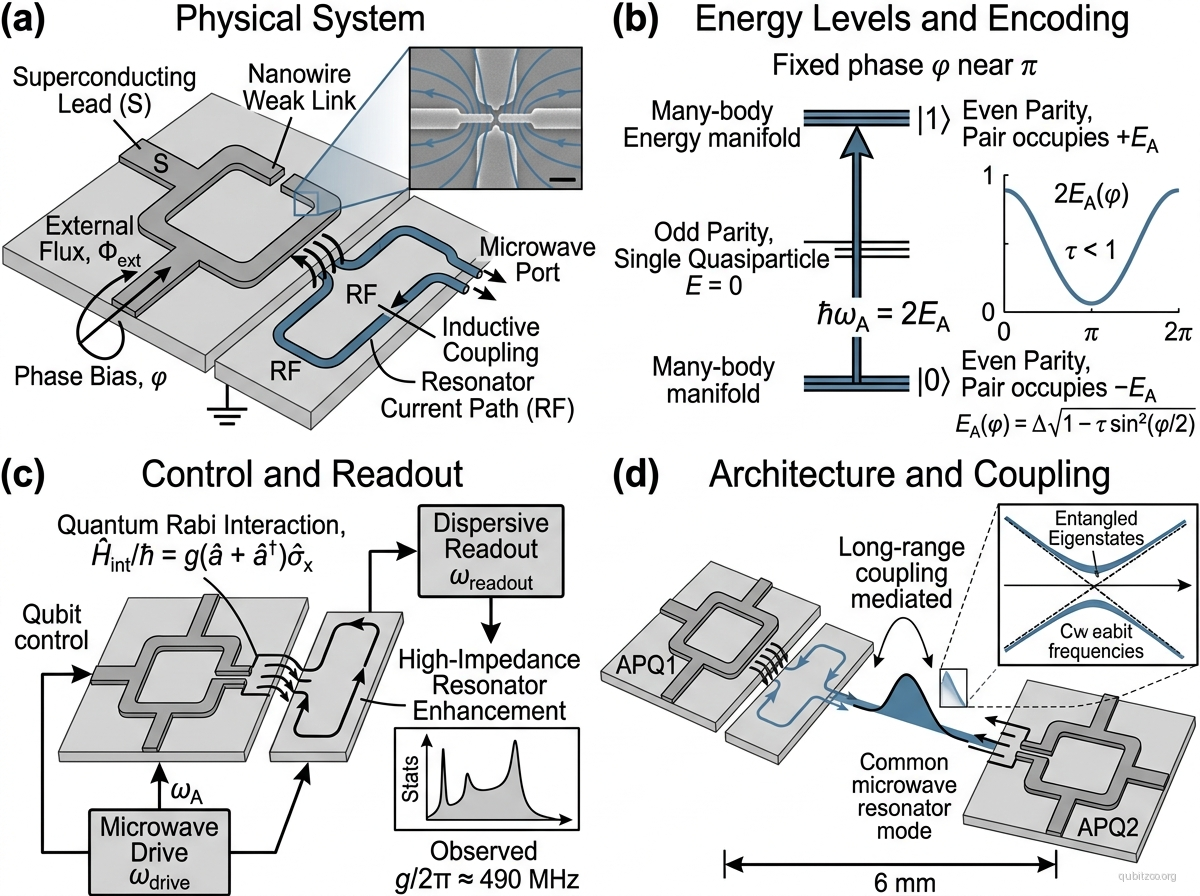
Description
An Andreev pair qubit uses the two even-parity states of one highly transmitting Andreev bound-state doublet in a superconducting weak link. The logical ground state has the negative-energy Andreev level occupied by a Cooper pair; the excited state has the positive-energy partner occupied. Their transition changes the occupancy by two quasiparticles while preserving even parity.
This is not the Andreev spin qubit. The pair qubit uses the even-parity ground/excited pair transition; the spin qubit uses the odd-parity spin degree of freedom of a trapped quasiparticle.
Hamiltonian
For a short, spin-degenerate channel of transmission ,
and the even-parity transition energy is . The logical states are the even-parity configurations with the negative-energy level pair occupied () or the positive-energy level pair occupied (); singly occupied configurations belong to the odd-parity sector.
A representative transverse two-level model for coupling to a microwave mode is the quantum-Rabi Hamiltonian,
For , the rotating-wave approximation reduces the interaction to . That approximation is not valid when the coupling approaches the ultrastrong regime. Flux tunes and therefore the qubit frequency; a resonator provides spectroscopy, control, readout, and remote coupling.
Motivation
- Use the microscopic degrees of freedom that carry supercurrent as a compact qubit.
- Tune frequency with phase bias and couple distant weak links through microwave photons.
- Probe few-channel Josephson physics with coherent-control tools.
Experimental Status
Zazunov et al. proposed the Andreev-level qubit in 2003. Bretheau et al. directly observed excited Andreev pair states by spectroscopy in 2013, and Janvier et al. demonstrated coherent control and single-shot circuit-QED readout in 2015. Cheung et al. demonstrated cavity-mediated coherent coupling between two pair qubits and identified entangled eigenstates across 6 mm in 2024. In 2025, Shvetsov et al. observed a pair-transition coupling of about 490 MHz to a high-impedance resonator and extracted larger phase-dependent couplings, approaching the ultrastrong-coupling regime. No peer-reviewed 2026 experiment found in this audit supersedes those pair-qubit milestones.
Key Metrics
| Metric | Value | Notes | Fidelity reference |
|---|---|---|---|
| Remote separation | 6 mm | Two pair qubits coupled through a microwave cavity mode | Cheung et al. 2024 |
| Frequency control | Flux/phase tunable | Follows | Bretheau et al. 2013 |
| Two-qubit interaction | Photon mediated | Avoided crossings and entangled two-qubit eigenstates | Cheung et al. 2024 |
| Coherent-control times | ; ; echo | Representative atomic-contact result at | Janvier et al. 2015 |
| Pair-transition resonator coupling | observed | High-impedance InAs–Al device; model gives MHz maximum for the fitted transition | Shvetsov et al. 2025 |
Scaling Considerations
- Quasiparticle poisoning moves the weak link between even and odd parity sectors.
- Atomic contacts and nanowire weak links require reproducible high-transmission channels.
- Flux sensitivity, dielectric loss, and cavity crowding remain system-level constraints.
- Universal calibrated two-qubit gates and processor-scale integration remain to be demonstrated.
- The 2025 high-impedance-resonator result strengthens light–matter coupling, but its largest inferred value lies beyond the perturbative model used to extract it and should not be read as a gate benchmark.
References
- A. Zazunov et al., “Andreev Level Qubit,” Physical Review Letters 90, 087003 (2003); arXiv:cond-mat/0206342.
- L. Bretheau et al., “Exciting Andreev pairs in a superconducting atomic contact,” Nature 499, 312–315 (2013); arXiv:1305.4091.
- C. Janvier et al., “Coherent manipulation of Andreev states in superconducting atomic contacts,” Science 349, 1199–1202 (2015); arXiv:1509.03961.
- L. Y. Cheung et al., “Photon-mediated long-range coupling of two Andreev pair qubits,” Nature Physics 20, 1793–1797 (2024); arXiv:2310.15995.
- O. O. Shvetsov et al., “Approaching the ultrastrong-coupling regime between an Andreev level and a microwave resonator,” Physical Review Applied 24, 044015 (2025); arXiv:2502.09243.
Linked Papers
- zazunov-2003-andreev-level-qubit
- bretheau-2013-andreev-pairs
- janvier-2015-andreev-coherent-control
- cheung-2024-andreev-pair-coupling
- shvetsov-2025-andreev-ultrastrong-coupling
Evergreen context
- josephson-junction-as-nonlinear-element — Andreev levels are the microscopic weak-link spectrum beneath the Josephson effect.
- jaynes-cummings-in-circuits — cavity coupling supplies the control and remote-interaction layer.
- spin-orbit-coupling-for-qubit-control — helps distinguish spin-active odd-parity Andreev devices from this even-parity pair encoding.
Related Entries
- andreev-spin-qubit — odd-parity quasiparticle-spin encoding in a hybrid weak link.
- gatemon — uses the same gate-tunable weak-link family but encodes in a collective circuit mode.
- circuit-qed — shared microwave coupling and readout architecture.