 Qubit Zoo
Figure
Description
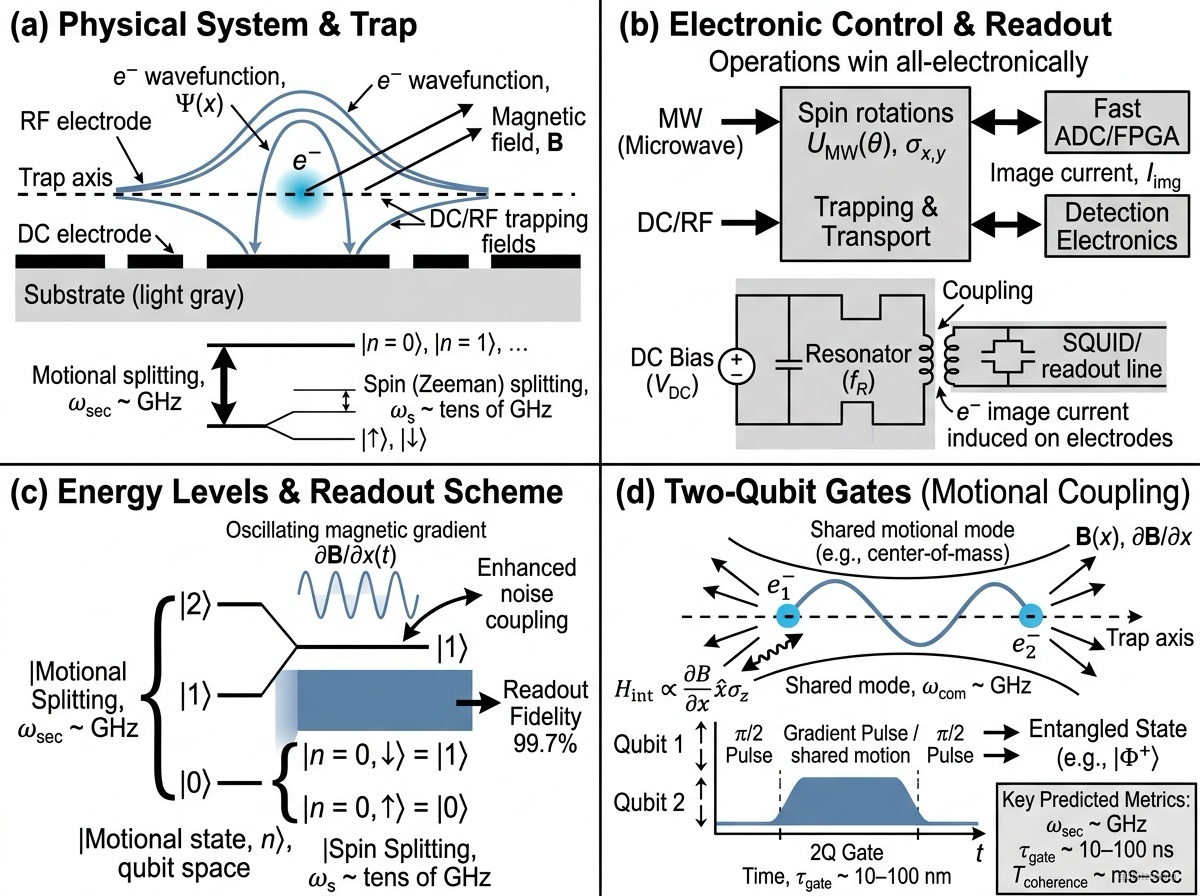
The trapped-electron qubit encodes quantum information in the spin state of a single electron confined in an electromagnetic trap — either a radio-frequency Paul trap or a Penning trap. The electron spin-1/2 provides a natural two-level system: and , split by the Zeeman energy in an applied magnetic field .
The fundamental motivation is the electron’s extraordinarily low mass: at kg, it is roughly 1,800× lighter than the lightest trapped-ion species () and over 250,000× lighter than . Since motional (secular) frequencies in a Paul trap scale as , electrons have motional frequencies in the GHz range (vs. MHz for ions). This translates to potentially much faster two-qubit gate operations — the ion’s shared-motion entangling gate speed is limited by the motional frequency — and faster transport in QCCD-style architectures.
Unlike trapped ions, electrons have no internal level structure beyond spin, eliminating laser-based state preparation, manipulation, and readout entirely. All control would be electronic: microwave fields for spin rotations, dc/rf electric fields for trapping and transport, and image current or cavity-coupled detection for readout. This “all-electronic” approach avoids the laser system complexity that is a primary scaling bottleneck for trapped-ion systems.
However, the same light mass that enables fast operations also creates challenges: the electron is highly sensitive to electric field noise (anomalous heating rates scale as , so heating is severe), and the spin readout — trivial for ions via fluorescence — requires sophisticated detection schemes using magnetic gradients and motional coupling (Peng et al. 2017) or coupling to superconducting resonators.
Hamiltonian
A single electron in a linear Paul trap with an applied magnetic field:
where is the electron mass, is the secular trap frequency (GHz range), and is the spin Larmor frequency.
For two-qubit gates, the spin-motion coupling is induced by a magnetic field gradient :
This couples the electron’s motional state to its spin, enabling Mølmer-Sørensen-type or geometric phase entangling gates via the shared motional mode, directly analogous to trapped-ion gates but at GHz motional frequencies.
The predicted two-qubit gate time scales as:
where is an effective Lamb-Dicke-like parameter for the spin-motion coupling, yielding predicted gate times of tens to hundreds of nanoseconds — comparable to superconducting qubits.
Motivation
Trapped-electron qubits aim to combine the best features of trapped ions (long spin coherence, identical qubits, motional-mode entangling gates) with the speed of superconducting circuits (ns-scale gates), while eliminating laser systems entirely. If the technical challenges of single-electron detection, ground-state cooling, and heating suppression can be overcome, trapped electrons could offer a uniquely scalable platform: all-electronic control, CMOS-compatible fabrication of surface traps, and gate speeds competitive with solid-state platforms while maintaining the isolation-from-material-defects advantage of trapped-particle approaches.
Experimental Status
Quantum information processing proposal — Daniilidis et al. (2013):
- Proposed interfacing trapped electrons with superconducting electronics via parametric frequency conversion.
- Designed a scheme for coherent quantum information transfer between electron motional states and superconducting resonators.
- Identified geometric nonlinearities in the trapping potential as a resource for coupling.
Feasibility study — Yu et al. (2022):
- Comprehensive theoretical analysis of trapped-electron quantum computing in a linear Paul trap.
- Proposed experimental sequence: trapping, resistive cooling to ~0.4 K, electronic detection, spin readout via magnetic gradients, and entangling gates.
- Simulated two-qubit Bell-state fidelities of ~99.99% under realistic parameters.
- Proposed QCCD architecture adapted for electrons, with transport times ~100× faster than ions.
Spin readout proposal — Peng et al. (2017):
- Proposed spin readout via oscillating magnetic field gradients in a surface Paul trap.
- Predicted readout fidelity of 99.7% in 25 μs.
- All-electronic scheme: no lasers or fluorescence required.
Electron trapping and detection — Taniguchi and Noguchi (2025):
- Demonstrated image current detection of electrons in a room-temperature Paul trap.
- Extracted electron signals via coupling to microwave cavity modes.
- Observed resistive cooling of trapped electron clouds.
- Key step toward single-electron ground-state cooling at cryogenic temperatures.
Electron dynamics simulations — Huang et al. (2025):
- Numerical studies of electron dynamics in linear Paul traps including Wigner crystal formation for multi-electron entangling operations.
- Analyzed cooling methods and stability under strong magnetic fields.
Status as of 2026:
- No trapped-electron spin qubit has been experimentally demonstrated. Electron trapping in Paul traps at room temperature and image current detection have been achieved, but single-electron isolation, ground-state cooling, and spin readout remain undemonstrated.
Key Metrics
| Metric | Value | Notes | Fidelity reference |
|---|---|---|---|
| Motional frequency | ~GHz | vs. ~MHz for ions; enables faster gates | Yu et al. 2022 |
| 2Q gate fidelity | ~99.99% (predicted) | Simulated Bell-state fidelity | Yu et al. 2022 |
| Spin readout fidelity | 99.7% (predicted) | Via magnetic gradient + motional coupling | Peng et al. 2017 |
| Gate time (2Q) | ~10–100 ns (predicted) | Comparable to superconducting gates | Yu et al. 2022 |
| Control mechanism | All-electronic | Microwave spin rotations, dc/rf trapping, image current readout | — |
| Operating temperature | ~100 mK (target) | Cryogenic needed for ground-state cooling; trapping at room temperature demonstrated | — |
Scaling Considerations
- Anomalous heating: the scaling of heating rates means electrons are ~10⁶× more susceptible to electric field noise than ions. Cryogenic operation and ultra-clean trap surfaces are essential, and the heating rate may ultimately limit gate fidelities.
- Single-electron detection: detecting and addressing individual electrons without fluorescence requires sensitive electronic readout (image currents, superconducting resonators). This has been demonstrated for electron clouds but not single electrons in Paul traps.
- Ground-state cooling: achieving motional ground state at GHz frequencies requires starting temperatures below ~50 mK. Resistive cooling followed by sideband cooling via spin-motion coupling is the proposed path.
- Magnetic field stability: the Zeeman splitting depends on magnetic field, requiring either shielding or clock-like transition schemes for long coherence.
- Fabrication compatibility: surface Paul traps for electrons can leverage CMOS fabrication technology, with electrode dimensions of ~10 μm, a potential advantage over ion traps requiring ~100 μm features.
- Comparison to ions: trapped electrons trade the proven, high-fidelity operations of trapped ions for theoretical speed advantages that remain unvalidated experimentally.
References
Proposals
- N. Daniilidis et al., “Quantum information processing with trapped electrons and superconducting electronics,” New J. Phys. 15, 073017 (2013) | arXiv:1304.4710
- P. Peng, C. Matthiesen, and H. Häffner, “Spin readout of trapped electron qubits,” Phys. Rev. A 95, 012312 (2017) | arXiv:1611.00130
- Q. Yu et al., “Feasibility study of quantum computing using trapped electrons,” Phys. Rev. A 105, 022420 (2022) | arXiv:2112.04034
Experimental progress
- A. Huang et al., “Numerical Investigations of Electron Dynamics in a Linear Paul Trap,” arXiv:2503.12379 (2025)
Linked Papers
- daniilidis-2013-trapped-electron-superconducting
- peng-2017-electron-spin-readout
- yu-2022-trapped-electron-feasibility
Related Entries
- trapped-ion-qubit — parent platform concept; electrons replace ions
- cirac-zoller-gate — entangling gate principle adapted for electron motional modes
- spin-qubit — broader spin qubit family