 Qubit Zoo
Figure
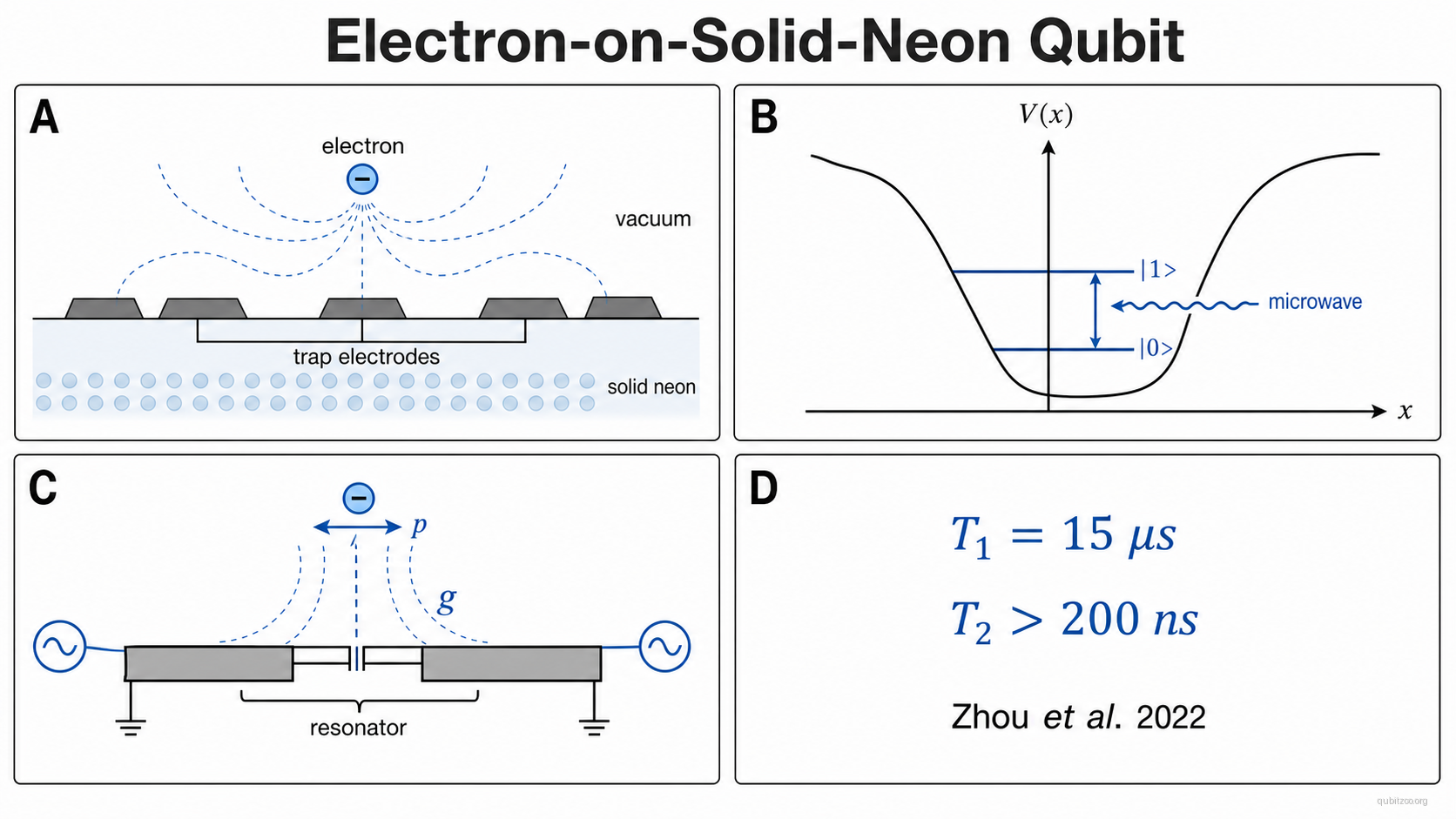
Description
An electron-on-solid-neon (eNe) qubit stores quantum information in two lateral motional states of a single electron floating in vacuum roughly a nanometre above a solid-neon film. Image-charge attraction binds the electron toward the dielectric surface, while the neon surface barrier keeps it out of the solid. Electrode voltages and the local neon topography jointly determine the in-plane confinement.
The encoded states and are the lowest selected eigenstates of this anharmonic lateral potential. Their electric-dipole transition couples strongly to the microwave electric field of a superconducting resonator, enabling circuit-QED control and dispersive readout without embedding the carrier in a semiconductor crystal. The demonstrated devices are charge-like motional qubits, not electron-spin qubits.
Surface morphology is both a resource and a liability. Nanoscale neon bumps can provide strong natural confinement, including ring-like states, but uncontrolled trapping sites make device parameters difficult to reproduce and can leave stray electrons that add charge noise. Proposed engineered or levitated-neon geometries aim to make trapping deterministic while retaining the vacuum interface.
Hamiltonian
After freezing the tightly bound vertical motion into its ground state, a useful lateral model is
where is set by the biased trap and guard electrodes and captures confinement from neon thickness and topography. The logical states are selected eigenstates , with . The anharmonicity convention used here is ; it need not have the negative sign familiar from a transmon.
Electric-dipole coupling to a resonator mode is described before truncation by
Restricting to and applying the rotating-wave approximation gives the Jaynes–Cummings form
For detuning with , the resonator acquires a state-dependent dispersive pull. The two-level estimate is ; quantitative work must retain higher motional levels and their measured anharmonicity.
Motivation
- Place a charge carrier in vacuum above an inert quantum solid rather than inside a noisy semiconductor interface.
- Combine fast electrical control with superconducting circuit-QED readout and resonator-mediated connectivity.
- Exploit a large motional dipole for strong coupling while pursuing sweet spots and surface engineering to suppress charge noise.
- Provide a possible charge-control interface for future electron-spin storage, which remains a distinct, not-yet-demonstrated eNe operating mode.
Experimental Status
First circuit-QED demonstration — Zhou et al. (2022):
- Demonstrated vacuum Rabi splitting with , coherent microwave control, and dispersive readout.
- Measured and Hahn-echo coherence ; the measured positive anharmonicity was about at one operating point.
Coherence and fidelity benchmark — Zhou et al. (2024):
- Extended relaxation and coherence into the regime, including , sweet-spot , and across the reported devices and bias points.
- Reported 98.1% single-shot readout fidelity without a quantum-limited amplifier and 99.97% average single-qubit gate fidelity from Clifford randomized benchmarking.
Confinement mechanism — Kanai et al. (2024):
- Showed theoretically that nanoscale solid-neon bumps can naturally confine electrons in ring-like lateral states, explaining why uncontrolled surface morphology can determine which electrons become usable qubits.
Surface-morphology trapping — Zheng et al. (2025):
- Experimentally compared resonator-trench depth and surface roughness, finding that shallow etching improves charge-state coupling and that fabrication-induced morphology controls the formation of strongly coupled electron states.
Multi-qubit control — Li et al. (2026 preprint; first posted 2025):
- Demonstrated coherent cross-resonance and bSWAP operations between interacting eNe charge qubits and observed direct charge–charge coupling up to in a three-qubit device.
- No two-qubit gate fidelity was reported, so this remains a control milestone rather than a fidelity benchmark.
Noise and temperature characterization — Li et al. (2026):
- Measured charge-noise spectra and maintained Hahn-echo coherence above for qubits near at temperatures up to .
Spin-compatible fast control — Wang et al. (2026 preprint):
- Demonstrated microwave readout and charge-qubit Rabi frequencies up to with a magnetic-field-compatible NbTiN nanowire resonator.
- The device still trapped the electron at an unintended surface site, underscoring that deterministic positioning remains unresolved.
Engineered deterministic trapping — Surse et al. (2026 preprint):
- Proposed a smooth dielectric underlayer with selectively etched trapping sites and supported it with coupled Schrödinger–Poisson simulations; this is a device-engineering proposal, not a demonstrated deterministic loader.
Key Metrics
| Metric | Value | Notes | Fidelity reference |
|---|---|---|---|
| Charge–photon coupling | 3.5 MHz | Vacuum Rabi splitting in the first device | Zhou et al. 2022 |
| 102.2 μs | Longest value in the 2024 study; bias point with reduced Purcell decay | Zhou et al. 2024 | |
| 42.8 μs | Ramsey dephasing at a charge sweet spot | Zhou et al. 2024 | |
| 92.9 μs | Hahn echo at the same sweet spot | Zhou et al. 2024 | |
| 1Q gate fidelity | 99.97% | Average Clifford randomized-benchmarking fidelity | Zhou et al. 2024 |
| Single-shot readout fidelity | 98.1% | No quantum-limited amplifier | Zhou et al. 2024 |
| Direct inter-qubit coupling | Up to 62.5 MHz | Three-qubit device; preprint, no 2Q fidelity reported | Li et al. 2026 |
| Charge-qubit Rabi frequency | Up to 76 MHz | NbTiN spin-compatible resonator; preprint | Wang et al. 2026 |
| Elevated-temperature coherence | s at 400 mK | Qubits operated near 5 GHz | Li et al. 2026 |
Scaling Considerations
- Uncontrolled neon morphology produces run-to-run trap variability, background electrons, and device-frequency disorder.
- Deterministic single-electron loading, positioning, shuttling, and reproducible inter-qubit spacing remain open engineering problems.
- The large motional dipole enables fast control and strong coupling but also increases sensitivity to electric-field fluctuations.
- Direct charge–charge coupling now supports coherent multi-qubit operations, but calibrated high-fidelity entangling gates have not yet been reported.
- Levitated-neon-particle arrays are a 2026 peer-reviewed proposal for separating the qubit host from substrate roughness; they are not yet an experimental processor architecture.
- An engineered dielectric underlayer with lithographically defined minima is a July 2026 preprint route to deterministic trapping; experimental validation remains open.
References
Experimental demonstrations
- X. Zhou et al., “Single electrons on solid neon as a solid-state qubit platform,” Nature 605, 46–50 (2022) — arXiv:2106.10326.
- X. Zhou et al., “Electron charge qubit with 0.1 millisecond coherence time,” Nature Physics 20, 116–122 (2024) — arXiv:2210.12337.
- X. Li et al., “Coherent manipulation of interacting electron qubits on solid neon,” arXiv:2503.23738 (2026 version; first posted 2025).
- X. Li et al., “Solid neon as a noise-resilient host for electron qubits above 100 mK,” Nature Electronics 9, 621–629 (2026) — arXiv:2502.01005.
- J. Wang et al., “Fast coherent control of a charge qubit on solid neon with a spin-qubit-compatible resonator,” arXiv:2605.31185 (2026).
Confinement and scaling
- T. Kanai, D. Jin, and W. Guo, “Single-Electron Qubits Based on Quantum Ring States on Solid Neon Surface,” Physical Review Letters 132, 250603 (2024) — arXiv:2311.02501.
- K. Zheng, X. Song, and K. W. Murch, “Surface-Morphology-Assisted Trapping of Strongly Coupled Electron-on-Neon Charge States,” Physical Review Letters 135, 080601 (2025) — arXiv:2503.01847.
- S. Inui et al., “On-Chip Levitated Neon Particle Arrays for Robust and Scalable Electron Qubits,” PRX Quantum 7, 033019 (2026) — arXiv:2512.00654.
- K. Surse et al., “Deterministic single-electron trapping on solid neon using engineered dielectric surface geometry,” arXiv:2607.13448 (2026).
Linked Papers
- zhou-2022-solid-neon-electron-qubit
- zhou-2024-neon-charge-qubit
- kanai-2024-neon-ring-states
- zheng-2025-neon-surface-morphology
- li-2026-interacting-neon-qubits
- li-2026-neon-noise-resilience
- wang-2026-fast-neon-charge-control
- inui-2026-levitated-neon-arrays
- surse-2026-deterministic-neon-trapping
Evergreen context
- jaynes-cummings-in-circuits — electron-photon strong coupling reduces to this interaction after two-level truncation and the rotating-wave approximation.
- dispersive-readout-mechanism — explains how the motional state produces a state-dependent resonator shift.
- charge-noise-sweet-spot — the central comparison for a strongly electric-dipole-coupled motional qubit.
- vacuum-rms-field-scaling — separates the resonator-side zero-point voltage from the electron’s large motional dipole, the two ingredients that together set the observed charge-photon coupling.
- purcell-protection-via-detuning — the measured values are Purcell-limited at most bias points; detuning from the resonator is the primary knob for extending the charge-qubit lifetime.
Related Entries
- semiconductor-charge-qubit — another electrically controlled charge-like encoding, but embedded in a semiconductor device.
- circuit-qed — shared microwave-control, strong-coupling, and dispersive-readout architecture.
- qubit-readout — system-level context for the demonstrated dispersive and single-shot measurements.
- spin-qubit — the proposed long-lived storage degree of freedom for future eNe devices; it has not yet been demonstrated on solid neon.