 Qubit Zoo
Figure
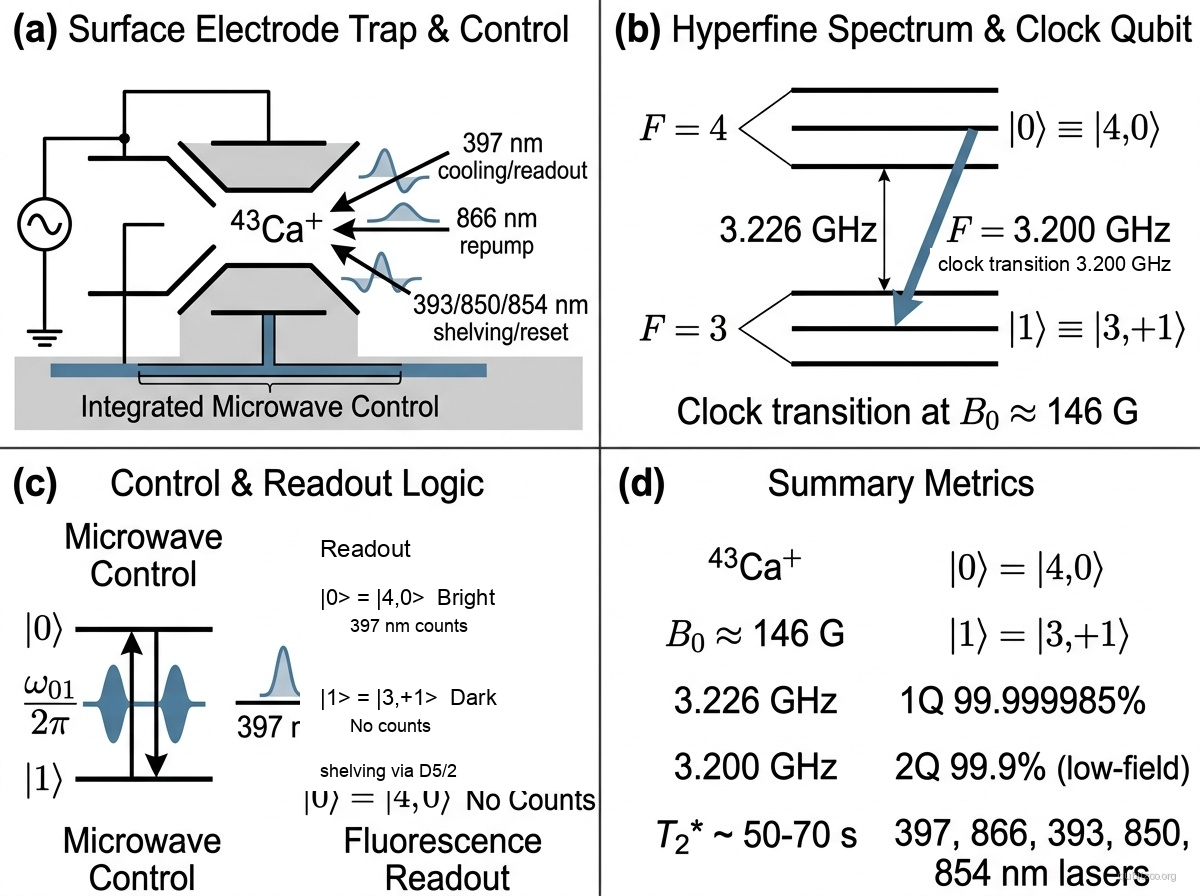
Description
The calcium-43 trapped-ion qubit stores quantum information in the hyperfine ground-state manifold of , whose nuclear spin splits the level into and manifolds separated by 3.226 GHz at zero field, for a total of 16 ground-state sublevels. In the Oxford high-coherence implementation, the qubit is encoded in the field-independent hyperfine transition at a bias field of about 146 G, giving a qubit frequency near 3.200 GHz and strong suppression of first-order magnetic-field noise. This operating point underlies the long memory times reported by Harty et al. (2014) and the record single-qubit fidelities reported by Smith et al. (2025).
The ion is the workhorse qubit of the Oxford trapped-ion program because it pairs atomic-clock-grade coherence with microwave control in a microfabricated surface-electrode trap. Chip-integrated microwave resonators and waveguides drive single-qubit rotations electronically, avoiding laser-based single-qubit addressing. Lasers are still required for Doppler cooling (397 nm), repumping (866 nm), shelving/reset (393/850/854 nm), and fluorescence-based state preparation and readout, but coherent single-qubit control itself is all-electronic.
Different experiments use different hyperfine encodings depending on the task. The best single-qubit results use the 146 G clock transition above, while Ballance et al. (2016) used a low-field Raman-driven hyperfine basis for the 99.9(1)% two-qubit gate result. Together these experiments make a benchmark species for long-lived, high-fidelity trapped-ion qubits.
Hamiltonian
For the ground manifold of (, ), the relevant Hamiltonian is the hyperfine-plus-Zeeman Hamiltonian
Because , there is no electric-quadrupole hyperfine term in this manifold. At zero field this produces the familiar and hyperfine manifolds with splitting . At finite magnetic field the eigenenergies follow the Breit-Rabi structure, and the Oxford clock qubit is chosen at the field-independent point near on the transition
with qubit frequency . Near that operating point,
so the first-order magnetic sensitivity vanishes. Separate low-field gate experiments on the same species use other hyperfine basis states; for example, Ballance et al. (2016) operated a Raman-driven two-qubit gate in a low-field regime rather than at the 146 G clock point.
Motivation
The system demonstrates that microwave-driven trapped-ion qubit gates can reach error rates deep into the fault-tolerant regime while preserving the long coherence times expected from hyperfine clock transitions. Microwave control offers fundamental scaling advantages: fields can be generated on-chip via lithographically defined resonators, avoiding the alignment, pointing stability, and individual beam-delivery burden of laser-based single-qubit addressing. The record -level single-qubit errors place 1Q operations effectively in the “error-free” regime for practical architectures, shifting the real bottleneck to entangling gates, optical infrastructure, and system integration.
Experimental Status
High-fidelity qubit operations — Harty et al. (2014):
- First comprehensive characterization of as a microwave-driven hyperfine qubit.
- Qubit encoded in the field-independent transition near .
- Single-qubit gate fidelity: 99.9999% (error ).
- State preparation and readout fidelity: 99.93%.
- Coherence time: in room-temperature surface-electrode trap without magnetic shielding.
- Demonstrated all coherent single-qubit operations using chip-integrated microwave resonators.
Two-qubit gate record — Ballance et al. (2016):
- Two-qubit gate fidelity: 99.9(1)% using a Raman-driven geometric phase () gate.
- Demonstrated in hyperfine qubits at Oxford in a low-field operating regime (), distinct from the 146 G clock-state operating point used for the 1Q record.
Single-qubit gate record — Smith et al. (2025):
- Clifford gate error: (fidelity 99.999985%).
- All-time record across all physical qubit platforms.
- Fastest gates (4.4 μs) achieved error of .
- Calibration errors suppressed below .
- Dominant errors: qubit decoherence (), leakage ( per gate), and measurement.
- Performed on a microfabricated surface-electrode Paul trap at room temperature without magnetic shielding.
Key Metrics
| Metric | Value | Notes | Fidelity reference |
|---|---|---|---|
| >10,000 s | Hyperfine ground states; practically limited by ion lifetime, not radiative decay | Harty et al. 2014 | |
| ~50–70 s | 146 G field-independent clock transition $ | 4,0\rangle \leftrightarrow | |
| Zero-field hyperfine splitting | 3.226 GHz | Separation between the and ground manifolds | Harty et al. 2014 |
| Operating qubit frequency | 3.200 GHz | Oxford clock-state operating point near | Harty et al. 2014 |
| 1Q gate fidelity | 99.999985% | Microwave randomized benchmarking, error ; all-time record across physical qubits | Smith et al. 2025 |
| 2Q gate fidelity | 99.9% | Raman-driven geometric phase gate in a low-field hyperfine basis, not the 146 G clock-state basis | Ballance et al. 2016 |
| SPAM fidelity | 99.93% | Single-shot fluorescence readout with shelving-based state discrimination | Harty et al. 2014 |
| Gate time (1Q) | 4.4–35 μs | Speed-fidelity tradeoff in microwave control | Smith et al. 2025 |
| Nuclear spin | 16 ground-state sublevels in the manifold | Harty et al. 2014 | |
| Operating temperature | Room temp (trap) | Ion motion cooled to mK scale; no cryogenic hardware required | Harty et al. 2014; Smith et al. 2025 |
Scaling Considerations
- Microwave scalability: chip-integrated microwave resonators enable on-chip qubit control without individual laser addressing, a major advantage for scaling to large arrays.
- Isotope abundance: has only 0.14% natural abundance, requiring enriched sources and isotope-selective photoionization for efficient loading.
- Large ground-state manifold: the 16 ground-state sublevels from increase the risk of leakage to non-computational states, though Smith et al. measured leakage at per gate.
- Two-qubit gates: the current 99.9% two-qubit fidelity lags behind the single-qubit record by orders of magnitude; closing this gap is the main challenge.
- Operating-point mismatch: the best 1Q and 2Q results were obtained in different hyperfine bases and magnetic-field regimes, so integrating record-level single- and two-qubit performance in one architecture remains an open systems challenge.
- Optical transitions: cooling and readout still require UV/visible lasers (397 nm, 866 nm, plus shelving/reset wavelengths), limiting the “all-electronic” advantage to qubit manipulation only.
References
High-fidelity operations
- T. P. Harty et al., “High-Fidelity Preparation, Gates, Memory, and Readout of a Trapped-Ion Quantum Bit,” Phys. Rev. Lett. 113, 220501 (2014) | arXiv:1403.1524
Two-qubit gates
- C. J. Ballance et al., “High-Fidelity Quantum Logic Gates Using Trapped-Ion Hyperfine Qubits,” Phys. Rev. Lett. 117, 060504 (2016) | arXiv:1512.04600
Single-qubit gate record
- M. C. Smith et al., “Single-Qubit Gates with Errors at the Level,” Phys. Rev. Lett. 134, 230601 (2025) | arXiv:2412.04421
Linked Papers
- harty-2014-high-fidelity-preparation
- ballance-2016-ion-gate-fidelity
- smith-2024-single-qubit-gate-errors
Related Entries
- trapped-ion-qubit — parent platform
- ytterbium-hyperfine-qubit — alternative hyperfine species, dominant in commercial systems
- strontium-88-ion-qubit — optical-clock trapped-ion species with a different control stack
- cirac-zoller-gate — foundational trapped-ion gate proposal